Smart Traffic Management involves controlling, managing and delivering traffic management in a data and technology driven environment, where traffic management involves enforceable measures and instructions implemented by the Road Authorities.
Latest update: 21 April 2023
Traffic Management

Traffic Management involves the management and control of traffic flow in towns and cities to keep them moving efficiently, using regulation, enforcement and optimisation.
If Traffic Management is not effective, then road safety may be compromised and the operation of the road network will be inefficient.
Efficient Traffic Management reduces congestion by managing access to limited road space, smoothing traffic flows, reducing air pollution and providing a better, and safer, overall experience for road users. Good Traffic Management has close ties with economic prosperity and the development of a town or city whilst helping to facilitate safe travel for vulnerable road users.
Traffic Management provision is linked, with and incorporated in, services discussed in several of the other Use Cases and close integration of these services can deliver wide ranging benefits.
Traffic Management has traditionally been carried out through a combination of physical road design, signs, and lines supported with regulatory enforcement or traffic signals.
It is not the purpose of this Use Case to go into detail of traffic signal operation, which is discussed in the Traffic Signals Use Case rather, the purpose here is to discuss how Traffic Management approaches should be linked to, and integrated with, other systems to take advantage of new and emerging technologies.
Traffic signals operate in a variety of environments: under local control or central control; following pre-planned fixed time, vehicle actuated or more complex algorithms with real time processing including MOVA for local control and SCOOT for central control. Idividual Traffic signals will be dependent on local detection, typically inductive loops cut into the road surface or above ground detectors such as microwave,radar or video detectors. Where there is a central control system, known as Urban Traffic Control, it will typically follow communications standards and protocols set out in the UTMC Specification, and particularly UG405 communications.
Poor Traffic Management causes issues such as:
- Congestion – increases travel times and adversely affects the economic prosperity of the urban environment.
- Delays and increased journey time – delays to private and public transport and commuters in the peak hours. Delays to public transport may deter the modal shift from private vehicles.
- Managing the impact of events and reacting to incidents, which cause significant perturbations in traffic demand and normal traffic flows.
- Changing demand at different times of year and at key periods, including for example school holiday periods and around retail centres at Christmas.
- Air pollution and noise – air pollution and noise adversely affect the quality of life in urban areas. Transport remains a major source of harmful emissions in cities (NOx, PM2.5, others).
- Mode choice – traffic management impacts mode choice and modal shift from private vehicles to more sustainable traffic modes, particularly public transport.
- Road space limitations – effective use and allocation of road space to sustainable traffic modes is one of the main issues in the urban environment, including through planned and unplanned events, such as roadworks.
- Lack of or limited network optimisation – non-existent or outdated network optimisation restricts capacity of the network that can be released if network is optimised effectively.
- Road safety – condition of the road environment and vehicle parameters such as speed, size, weight, and condition are factors impacting the safety and welfare of road users.
- Vulnerable road users – protecting vulnerable road users, minimising hazards and providing travel options to encourage use oaf active travel modes.
- Goods delivery – transportation of goods is essential to sustain economic prosperity. Smarter management of goods delivery, particularly the last delivery mile, can help alleviate congestion at peak times. While there is a link to the LAMP Freight Use Case cars being used as delivery vehicles are indistinguishable from private cars to sensing technologies.
- Enforcement – enforcement raises the level of compliance with controls and traffic management regulations as part of the “Engineering, Education and Enforcement” approach to road safety, including defining a clear, data backed, enforcement strategy.
- Aging equipment with associated maintenance , interface and integration constraints and the need to avoid supplier lock-in when upgrading and renewing traffic signal equipment.
High-level objectives
Traffic Management Services support the following objectives:
- Improved road safety through data driven and targeted traffic management interventions, supported by road safety focussed enforcement strategies.
- Smoothing traffic flow avoiding congestion and reducing delays or other policies such as redistributing demand.
- Enabling operational savings through renewals and the employment of new technologies which may include centralising the traffic management service, and/or utilising Traffic Management as a Service (TMaaS).
- Enabling operational savings through employing common standards supporting integration whilst providing appropriate cybersecurity and privacy protection.
- Supporting economic prosperity of the urban environment through the efficient management of the network, including minimising the impact of unplanned incidents, increasing reliability of journey times, and reducing delays.
- Encourage modal shift through management of the network to prioritise sustainable travel modes.
- Providing reporting systems that enable fast and efficient management decisions to support rapid incident response.
Supported policies and duties
Traffic Management Services support the following policies:
- The government’s National Infrastructure Strategy and the DfT’s Transport decarbonisation plan discuss decarbonisation through places. This is supported by traffic management measures that smooth traffic flows, prioritise the use of sustainable travel modes, and improve air quality.
- The UK Government’s National Data Strategy sets out an action plan which includes the mission of transforming government’s use of data to drive efficiency and improve public services. The UK Innovation Strategy sets out the Government’s ambition for the UK to be a global hub for innovation with the world’s best innovation ecosystem including:
- – Continual adoptation of new products and technologies.
- – Capitalising on data – creating an environment where data is usable, accessible and available.
- – Designing successful innovation – putting the needs, wishes and behaviours of people at the heart of the innovation process.
- Implementing and demonstrating the network management duties placed on local traffic authorities by the Traffic Management Act 2004 including:
- – Securing the expeditious movement of traffic
- – Securing the more efficient use of their road network
- – Avoiding/eliminating/ reducing congestion/disruption to the movement of traffic
- Traffic management services may support other policies, including the Authority’s plans and priorities to be achieved or further developed. These may include
- – Addressing inequalities and severance issues, which may relate to duties under the Equality Act 2010 and/or Disability Discrimination Act 2005.
- – Improving road safety
- – Economic prosperity
- – Changing use of land
- – Improving air quality and reducing noise
- – Improving transport efficiency and reliability
- – Modal shift
- – Tacking climate change
- – Promoting active and sustainable travel
- – Delivering improved customer services
Qualitative Benefits
Traffic Management Services can support the following benefits:
- Road safety and security
- Productivity due to predictable travel/commute time
- Reduced private car usage
- Traffic Management system efficiency
- Road user experience
Quantitative Benefits
Traffic Management Service can support the following benefits:
- Traffic delay management for private and public transport
- Journey time reliability for all transport modes
- Improved road safety, reduction of traffic accidents
- Reduced road traffic collisions response time and recovery time
- Reduced operational costs through renewals or new technologies
- Goods delivery systems implementation reducing delays for service and goods delivery vehicles
- Reduction in air pollution and noise
- Improved road management and traffic flow prediction
- Optimised freight operations
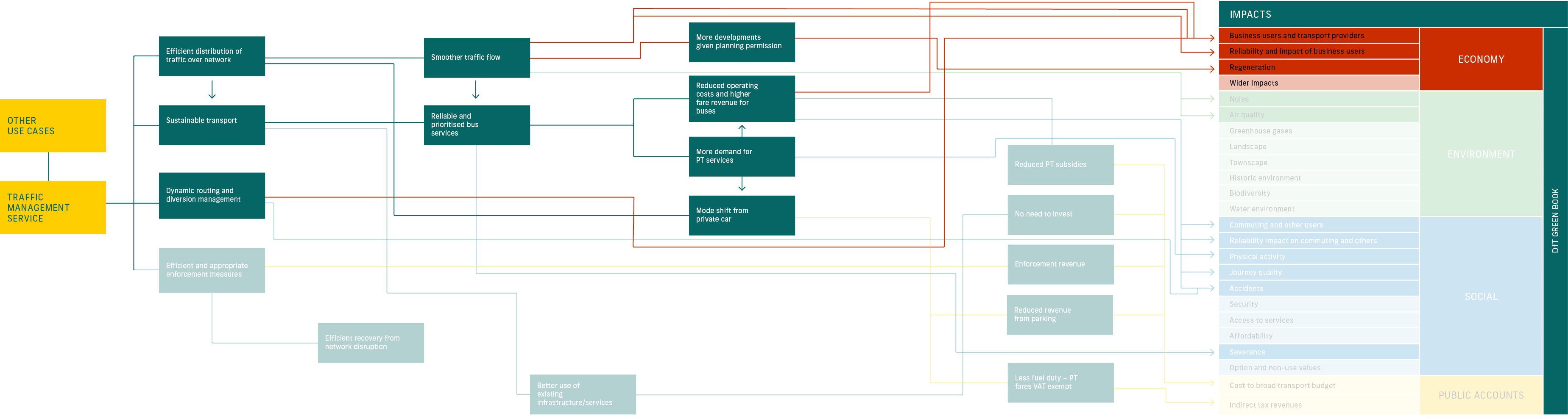
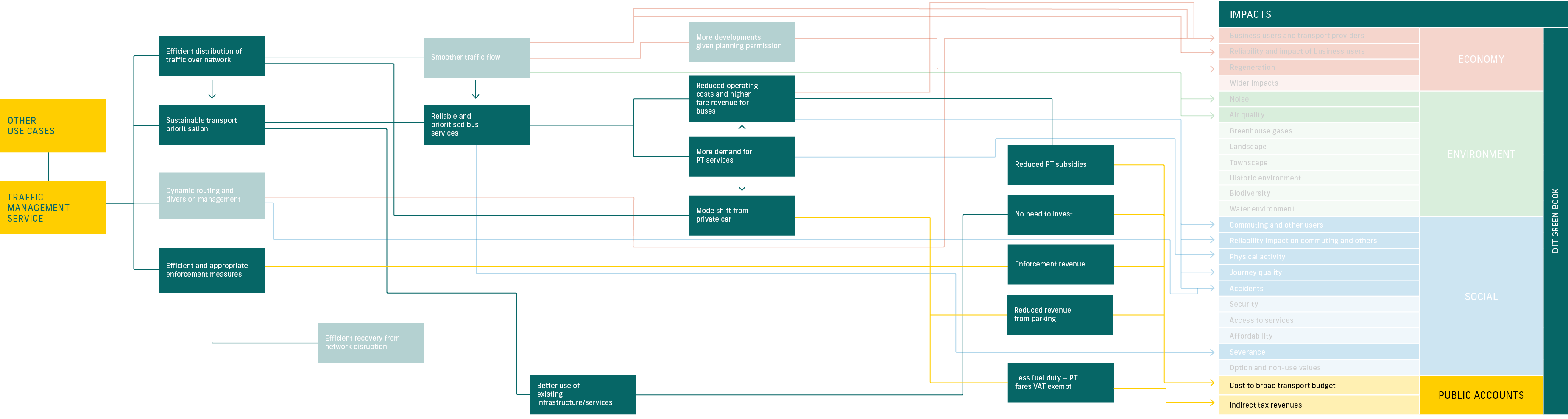
View by impact type:



DRAG
Introduction
This section intends to support the development of plans and specifications by providing the following information:
- Actors: who need to be considered in the development of the system.
- Architecture and Data flows: showing how administrators and users interact and use the system, to help identify and develop the needs and specifications of the system.
- Standards: that are important and how these are used in the context of this Use Case.
- Possible future developments: in practices and technology that may provide opportunities in the future.
The Use Case architecture is an idealised view of the complete service. Individual suppliers’ solutions may offer different parts of this complete service, but integration of such parts can be delivered through the use of standards and common protocols.
Actors
The service design is functionally described by the interaction between the service and the actors (any user or system that interacts with the service).
The following actors need to be considered in the development of the service design:
- Road users: users of all travel modes affected by the service: private transport, public, freight/goods, walking, cycling.
- Authority Traffic Manager: responsible for the transport network to keep the traffic moving.
- Service providers within the centralised Traffic Management System service.
- Emergency services or representatives of user groups with special characteristics such as Vulnerable Road Users.
From the perspective of this Use Case, the focus of the description of the service is the journey of the user through their interaction with the system. This Use Case does not describe the processes that a Local Authority will go through to develop a fully functional integrated traffic management system.
Architecture and Data Flows
For the purpose of the information and diagram presented in this section, a road user journey is defined as as a single journey undertaken by one vehicle. However, similar activities apply to navigation service providers and logistics managers.
The data flows are illustrated in in Figure 2 and Figure 3.
The data requirements and data flows are tabulated in Figure 4.
Interfaces
Interfaces between systems and services will depend on the specific design and the boundaries with other systems (regional, international) and services.
The general principle is that interfaces should be specified to use standardised data flows and protocols wherever standards are available, then following standards will support the integration of traffic management services.
Standards
It is important to align with and/or support the development of National Standards:
- To ensure the digitalised services used by customers are Authority agnostic and that different apps/services are not required for individual towns and cities.
- To ensure the services can interface with recognised customer-facing accounts e.g., Google, Apple, OEM3 -based services.
DATEX II (CEN/TS 16157) is a multi-part set of international data content and framework standards for road transport and traffic telematics.
Under the European ‘Co-operative Intelligent Transport Systems’ (C-ITS) programme a range of standards have been produced and are continuing to be developed. ITS specifications in general are developed to address specific domains such as public transport, road safety, freight and logistics, emergency services and systems such as electronic fee collection.
C-ITS services are based on the concept of data exchange between vehicles of any category, the roadside infrastructure, control and service centres and other road users such as pedestrians and cyclists with guidelines on their use published by ISO and CEN.

Figure 2 – The User Journey


Start
Plan
Start
Travel
End

What the user needs
- Route choice, projected journey time and restrictions (including time-based restrictions)
- Alternative travel times and mode choices
- Traffic condition information
- Route advisory information
- Predicted journey time
- Real time travel data
- Changes to arrival time
- Optimised routing
- Guidance through the network
What the system needs from the user
- User start origin
- User start time
- User end destination
- Journey purpose
- Journey preferences (shortest, fastest, quietest, cheapest, greenest route or travel time)
- Type of vehicle
- User location
- User choices of mode, route, journey start time
- Regular update of user location
- Compliance with the system (speed, traffic lights, advisory speed, etc.)
- Any changes to initial journey
- Feedback on journey
- Feedback on travel information
- Confirmation of end of journey
Data requirements
- Vehicle classification
- User profile (preferences)
- User journey information
- Current Network status
- Routing options
- Traffic planned and unplanned incident data
- Journey pricing data (tolling, congestion or emission charging)
- Traffic signal timing data
- Traffic real time data
- Predicted traffic situation
- Incident data
- Planned and emergency roadworks data
- Special events information
- Road user location data
- Public and Active transport data
- Weather condition data
- Real time traffic data
- Predicted traffic data
- Signal green light optimised speed advisory (GLOSA) data
- Hazard data
- Incident and events data
- Accidents data
- End time and location
- Journey/trip log
- Predicted vs actual journey time
DRAG
Figure 3 – Relevant Standards for User

Start
Plan
Start
Journey
Journey end
Relevant standards and key legislation
- CEN/TS 16157 Intelligent transport systems – DATEX II data exchange specifications for traffic management and information
- ISO 19136:2007 Geographic information – Geography Markup Language (GML)
- ISO/TS 21219: Intelligent transport systems – Traffic and travel information via transport protocol experts group, generation 2 (TPEG2)
- ISO 17572 series: which specifies location referencing methods that describe locations in the context of geographic databases
- ISO 8601 Date and Time format
- RFC 3339 Date and Time on the Internet: Timestamps
- ISO 14825:2011 Intelligent transport systems – Geographic Data Files (GDF) – GDF5.01
- CEN/TS 16157 Intelligent transport systems – DATEX II data exchange specifications for traffic management and information
- ISO/DIS 14819 Intelligent transport systems – Traffic and travel information messages via traffic message coding
- ISO TPEG2 21219 series- Intelligent transport systems – Traffic and travel information (TTI)
- CEN/TS 16157-6:2015: Intelligent transport systems. DATEX II data exchange specifications for traffic management and information
- EN 16157 which specifies and defines component facets supporting the exchange and shared use of data and information in the field of traffic and travel
- PD ISO/TS 21219: Intelligent transport systems. Traffic and travel information via transport protocol experts group, generation 2 (TPEG2)
- UK Government Service manual for measuring user satisfaction
DRAG
Figure 4 – The Traffic Management Manager’s Activities


Start
Monitor physical assets
Monitor transport network
Manage enforcement
Manage accidents and events
Reports and Monitor physical assets dashboards
What the manager needs
- Current asset installation information
- Compatibility of assets
- Maintenance alerts
- Assets database
- Effective communications (if required)
- Ability/rights to change configuration of assets
- Asset condition information
- Integrated interface
- Centralised service (all information in one package)
- Control of all assets that are able to change the traffic state
- Access to database
- System generated reports on violations
- Accurate data of violation
- Automated service
- System reports, network analysis on hotspots
- Event planning time frame
- Real time alerts
- Mitigation strategies
- Accident prediction system
- Graphical interface
- Data to populate the interface
- Analytical tools and dashboards
What the system needs from the manager
- Alert specification
- Asset compatibility and validation specification
- Effective communications asset failure management and notification
- Threshold settings for optimisation
- Standardised communication between different parts/elements of the system
- Clear standards
- Access to vehicle database
- Incident/event severity
- Incident/Event Recovery plan
- Performance targets for system recovery
- Required data to populate the dashboard
- KPI requirements
- Reporting intervals
Data requirements
- Asset state, real time updates
- Desired state of each asset
- Current state of assets
- Asset ownership and responsibility
- Signal data
- Network congestion data (vehicles per link, vehicle speeds)
- Origin/destination data from ANPR
- Queue data
- Traffic monitoring CCTV database (map)
- Vehicle speed data
- Vehicle number plate data
- Vehicle parking data (start time/end time)
- Red light violation data
- Yellow box violation data
- Historical accident data
- Accident severity data (slight, serious, fatal)
- Accident duration data
- Accident location data
- Special event duration (start/end)
- Road list affected by special event
- Vehicle journey time data
- Network saturation data
- Delay data
- Bus performance data (delays, journey times, excess waiting times)
- Accident data
- Road closure data
- Planned and unplanned roadworks data
DRAG
Figure 5 – Relevant Standards for Manager

Start
Monitor physical assets
Monitor transport network
Manage enforcement
Manage accidents and events
Reports and Monitor physical assets dashboards
Relevant standards and key legislation
- The Traffic Signs Regulations and General Directions (TSRDG) 2016
- PD CEN/TS 17241:2019 Intelligent transport systems. Traffic management systems. Status, fault and quality requirements
- ISO 17572 series: which specifies location referencing methods that describe locations in the context of geographic databases
- Traffic Management Act 2004
- CEN/TS 16157 Intelligent transport systems – DATEX II data exchange specifications for traffic management and information – Part 1: Context and framework – Part 2: Location referencing – Part 3: Situation publication – Part 4: Variable Message Sign (VMS) Publications – Part 5: Measured and Elaborated Data Publications – Part 7: Common data elements
- UTMC Technical specification www.utmc.eu/technical-specification including Technical Specification, Framework Specification and Objects Register with UG405 for traffic signal integration
- The Traffic Signs Regulations and General Directions 2016
- The Local Authorities’ Traffic Orders (Procedure) (England and Wales) Regulations 1996
- Local Authorities’ Traffic Orders (Procedure) (Scotland) Regulations 1999. Road Traffic Regulation (Northern Ireland) Order 1997
- National standards for Bailiffs and enforcement agents: Minimum standards for bailiffs and enforcement agents involved in taking goods from people who owe others money
- Taking Control of Goods Regulations 2013
- Taking Control of Goods (Fees) Regulations 2014
- Certification of Enforcement Agents Regulations 2014
- Tribunals, Courts and Enforcement Act 2007
- Electronic Fee Collection (EFC) relevant standards which are developed by CEN/TC278/WG1 and ISO TC 204/WG5
- UK CCTV and recording devices for traffic offences: list of certifications granted
- ISO/TS 21219-15:2016 – Intelligent transport systems – Traffic and travel information (TTI) via transport protocol experts group, generation 2 (TPEG2) – Part 15: Traffic event compact (TPEG2-TEC) • ISO/IEC 27035 is the international Standard for incident management
- ISO/IEC 22301 is the international Standard for business continuity management systems (BCMSs), and forms the final part of cyber resilience
- ISO 20121 Sustainable events: offers guidance and best practice to help manage events and control their social, economic and environmental impact
- CEN/TS 16157 Intelligent transport syste ms – DATEX II data exchange specifications for traffic management and information – Part 1: Context and framework – Part 2: Location referencing – Part 3: Situation publication
DRAG
Possible Future Development
Ongoing developments to technology are likely to continue to change the way that users receive and access information and change the data sources available to Authorities for monitoring and understanding their network.
The Co-operative intelligent traffic systems (C-ITS) platform now have a significant body of standards and technical specifications. However, the use-case relevant for traffic signal controls is not yet mature enough for availability of products on the open market but numerous trials have taken place in the UK and abroad including:
- Trials of GLOSA services, such as in York, Birmingham, Manchester, by National Highways and Coventry (UK CITE)
- The PATH project for traffic signal monitoring using floating vehicle data across 11 UK Authorities
- Surface Intelligent Transport System (SITS) TfL
- The Eboracum project for signal plan selection using floating vehicle data
- The A2M2 connected corridor and InterCor operations
- The FLOURISH C-ITS trials in Bristol
While conventional ITS systems include Authority controlled sub-systems (roadside equipment, traffic control centres), a central focus of current development is the devices travellers carry with them and have in their vehicle –such as ‘smartphones’ and ‘sat navs’. Such devices are able to communicate or share information with traffic management service providers and are expected to lead to improved road safety, traffic efficiency and service reliability.
The Traffic Management Use Case is focused on the services to be deployed by Authorities and the interfaces to these subsystems. Some of the functions of this use case will be similar regardless of the underlying technology to be deployed, so the focus of an Authority should be on delivering services and compiling accurate and complete data sets for integration with services from other providers.
However, it is worth understanding some of the background. Vehicle regulations are harmonized globally by UNECE, and it is expected that the UK will remain aligned with European regulations and standards regarding V2X. There is uncertainty around which platform will be adopted for V2X communications as there are competing proposals for implementing V2X either by extending Wi-Fi technology or by utilising the rollout of the next generation of cellular ‘5G’ technology. In Europe ETSI are leading the development of standards for the application of these technologies to C-ITS, which they term as ITS-G5 and C-V2X respectively.
While these developments will continue, Authorities should nevertheless:
- Develop and make available high quality data that is easy for service providers to access and make available to the public.
- Focus on service quality and service levels so accuracy of data feeds can be trusted.
- Ensure published standards are used for interfaces wherever possible to maximise the potential for intregation and consumption of the published data.
- Provide opportunities for service providers to trial new services to continue to learn and develop their capabilities in real-wordl environments.
- Assess whole life costs when considering investments in ITS systems and investigate the use of alternative data sources (‘smartphones’, ‘sat navs’, video analytics) to enhance traditional ITS sensors.