Smart Parking Management services support users to find and pay for suitable parking by providing real-time availability and accessibility information. It supports Authorities and car park owners to operate parking services effectively, meeting needs for traffic management and safety and managing kerb space availability for residents, business and commerce.
Latest update: 21 April 2023
Parking Management

Parking management is an important part of the mobility ecosystem. Providing parking services enables flexible mobility for road vehicle trips, affecting trip origin and destination, supporting the use of transport interchanges and multimodal connections as well as providing access to commercial, business and residential properties. The availability, accessibility and cost of parking influences trip and mode choices, whilst the operation and enforcement of parking affect traffic flows and delays experienced by road users. It forms an important element for travel demand management strategies.
Smart parking management complements traditional parking services and uses connected data and sensors to optimise the management of parking activities. Such technologies can be deployed within diverse parking facilities (both on-street and off-street) and ease the stress of parking by directing drivers to available parking spaces, thereby reducing uncertainty as well as delays due to looking for a free space. Improving the user’s experience by:
- Providing parking information during journey planning and travel to support and optimise suitable choices that support individual needs including accessibility requirements.
- Enabling travel choices supporting convenient access for transition between private transport and the final destination
- Providing easier and more flexible ways to pay for parking.
Smart parking management provides opportunities for Authorities by:
- Providing real-time data to enable more efficient monitoring, enforcement and management.
- Enabling migration to alternative payment methods improves security and efficiency, and reduces the potential for fraud.
- Supports integration of parking with other services as part of a wider mobility offering.
The need for Smart Parking Management
Parking is vital to support transport interchanges, commercial and business operations and residential access. The management of parking has a significant influence on the performance of traffic networks and is a highly visible and often emotive provision for customers, drivers and residents.
Smart Parking Management provides opportunities to deliver efficiencies and improved services through better data provision for parking users, including:
- Data exchange to assist journey planning and booking/navigating to available parking spaces.
- Drivers are guided to available spaces provides more direct journeys, saving time, reducing pollution and congestion.
- Users are able to find facilities that meet their individual requirements, including accessibility needs.
- The customer receives a more seamless higher quality service.
- Influence transport mode choice for example by providing information on transport interchanges with park and ride facilities where this links to other travel options (e.g. bus, coach, rail, metro).
The adoption of connected and digitalised services provides Authorities with options for providing parking:
- Connected data services provides an alternative to VMS signs that are expensive to maintain and may clutter the streetscape.
- The use of real-time data and connected parking transactions allows more dynamic and flexible use of parking facilities, increasing their operational utilisation and turnover.
- Improved user experience and ease of use.
- Management of cash incurs significant operational costs and risks including:
- The collection and management of cash.
- Theft from parking machines/meters or loss of income due to organised crime.
- Significant costs to maintain and empty parking meters/machines.
- Migrating from paper to digital permits reduces operational costs and removes issues of theft or fraud.
- The adoption of connected and digitalised parking services provides higher quality more timely data which can be used to direct enforcement resources more effectively.
- The wider digitalisation of parking management includes integration with:
- Digital Traffic Regulation Order (D-TRO) records and process.
- Digital co-ordination of, and integration with wider Authority processes such as network management.
Current trends
Significant migration from paper to digital permits has already occured, for example: controlled parking zones and visitor permits. This has reduced administrative costs and fraud, and provided opportunities for operating permitting more flexibly.
The operation of cashless and/or machine-less parking operations, such as payment by phone, is now widespread within many Authorities delivering service improvements and savings. However, it has highlighted challenges providing interoperability between providers and seamless services to end users. In part to address these issues, in 2019 parking data standards were published by the Alliance for Parking Data Standards these continue to develop and expand into international standards that cover parking data and incorporation with wider services.
The Department for Transport, via Manchester City Council, are piloting a National Parking Platform (NPP). Which will provide a range of nationwide data services for parking, including data on parking locations, tariffs and occupancy, as well as payment services.
More generally, travel behaviour is becoming increasingly influenced by connected data services:
- Vehicle manufacturers providing data connectivity and digital services including in-vehicle connected navigations systems providing parking availability, accessibility and tariffs, as well as individual parking space data in some cases.
- Use of third party planning and navigation services, that may include use of use crowd sourced data to provide enhanced services such availability of parking spaces, as well as areas where parking restrictions apply, or traffic issues en-route.
- Use of low-cost fixed sensors
The shift in the influence of connected data generates a need to adopt new approaches and practices to meet user and Authority expectations.
High-level objectives
The adoption of Smart Parking Management supports the achievement of outcomes including:
- Providing value for money to the taxpayer:
- Reducing the cost of collecting parking revenue, increasing the net surplus for use on other services.
- Providing a high-quality customer experience in line with other sectors where this is the norm:
- Drawing experiences from digitalised services such as online booking and ticketing for events or holidays and travel.
- Aligning strategically with other digital services:
- Enabling the Authority to move in an agile, flexible, proactive way to trial and adopt new services. (DfT Traffic Regulation Order (TRO) Review Study, 2018)
- Improving customer satisfaction and reducing complaints:
- Providing clear information of where and when parking is permitted and digital evidence of why a driver has been charged when a PCN is issued.
- Apps and in-car services that are GPS-based and time-stamped are able to provide unambiguous, machine auditable records of parking.
- Enabling integration with existing or future payments for related services for example Clear Air or Low Emission Zones.
These outcomes are supported by the implementation of the following objectives:
- Supporting new parking policies:
- Flexible tariffs such as: pay per minute; dynamic pricing to discourage unwanted parking behaviours; and combined EV charging and parking transactions.
- Enabling kerbside management
- Adoption of connected data in parking operations
- Supporting more efficient and effective operations by providing dynamic and higher quality data and digitalised processes.
- Digital sharing and publication of parking data
- Enabling connected services for customers: allowing easier and better planning based on the availability of parking space and eligibility of vehicles to occupy the space; and cost.
- Integration of parking data and processes with other kerbside and nearby facilities:
- Providing the opportunity to integrate parking data and processes of these with other services such as electric vehicle charging or loading/unloading management for freight and commerce.
- Enabling integrated and better-connected services for drivers/customers, making better use of existing facilities and improved access to local businesses.
- The digitalisation of parking management and coordination with other services:
- Enabling integration of parking management and with other Authority services.
- Greater transparency and availability of information when dealing with disputes.
- Potentially less confrontational relationships with vehicle owners.
- Migration to cashless parking operations:
- The adoption of digital parking services provides opportunities to migrate from cash-based transactions to electronic payment.
- This is key to future vendor-agnostic parking services as provided by the NPP.
- Reduces administrative costs and exposure to crime.
- Requires careful management to avoid discrimination against the unbanked or digital exclusion.
- Migration from paper to digital ticketing and permitting:
- Creating the opportunity to migrate paper tickets and parking permits to digital ones.
- Reduces administrative costs, the use of materials, and provides a better interface for users and allows more dynamic provision of services.
- May create an improved user experience, with consequential benefits for retail and the High Street.
Supported policies
Smart Parking Management supports the following policies:
- The Government’s National Infrastructure Strategy and the DfT’s Transport decarbonisation plan highlight the importance of moving towards the use of electric vehicles and developing the UK’s EV charging ecosystem. Smart parking management can play a key role in supporting this by providing information on charging facilities to drivers by linking parking data services and information sharing services together. Digital parking management helps improve travel planning and guidance, thereby reducing congestion and improving air quality. Digitalising operations lowers the costs and barriers to implementing services that increase vehicle utilisation, and efficiencies such as car clubs/freight delivery scheduling. Digitalised parking services allow more dynamic and connected facilities and services for users that support a wider range of choices, supporting active travel and more effective use of parking resources. The National Parking Platform (NPP) is an initiative that supports these policies.
- The Government’s UK Industrial Strategy and the Future of Transport Programme sets out actions to promote beneficial changes to transport. Early steps include providing funding for Authorities to make their parking and traffic management data available and publishing the first National Parking Data standards. Which has evolved to include the scoping and deployment activities for the National Parking Platform.
- The UK Government’s National Data Strategy sets out an action plan including the mission of transforming the Government’s use of data to drive efficiency and improve public services. The UK Innovation Strategy sets out the Government’s ambition for the UK to be a global innovation hub including:
- – Continual adoption of new products and technologies.
- – Capitalising on data – creating an environment where data is appropriately usable, accessible and available.
- – Designing successful innovation – by putting the needs, wishes and behaviours of people at the heart of the innovation process.
- Adoption of technology and digitalised processes may support the achievement or further development of, an Authority’s policies. Delivering quality customer services is strongly supported by providing well connected, digital services that can communicate with, and provide information on, parking facilities for customers. For example: providing increased ease of access and enhanced information relating to accessibility and surrounding facilities may also help to improve monitoring and satisfaction of duties placed on the Authority by the Equality Act 2010 and/or Disability Discrimination Act 2005.
- The DfT has launched a consultation covering proposals relating to the use of Digital TROs. If future legislation is adopted, handing and publishing TROs digitally would improve coverage and completeness of digital information for services accessing these records.
Qualitative Benefits
Smart parking management provides the following qualitative benefits:
- New/improved travel planning and navigation services, increased scope and flexibility of parking services, improved customer experience and access.
- Making parking asset data digitally available to users, either directly or via third parties improves services for users.
- Helping users to make more informed choices and encourage more sustainable travel choices.
- Improving users’ access to services and information, providing an overall improvement in customer experience.
- Improved management of traffic issues and provision of flexible services:
- Improved digital services enables better travel planning to locate and use parking facilities, improving customer experience.
- Supporting enforcement operations with digital data and processes helps direct resources and processes more effectively.
- Improved transparency and availability of parking information.
- The adoption of digital communications enables information to be shared with customers automatically and accurately. Improving customer service and reducing the potential for disputes.
- Accelerated uptake of electric vehicles.
- Providing information on charging facilities as part of digital parking information services helps to overcome barriers to use of electric vehicles and promotes their use and ownership.
- More efficient and effective organisational operations, reduced exposure to theft/fraud, and supports business operations.
- Digitalised processes, migration to cashless transactions and digital permits reduces costs/losses and enables more efficient methods of working.
- Adoption of digital communication and digitalised processes provides opportunities for providing greater integration into wider authority operations.
Quantitative Benefits
Parking Management Service supports the following quantitative benefits:
- Reduced traffic congestion
- Improved digital services enables optimised guidance to parking facilities, reduces journey times, and stress on congested roads.
- Supporting enforcement operations with digital data and processes improves the accuracy of enforcement operations.
- Reduction in physical infrastructure, reduced maintenance costs, reduced expenditure and increased revenues.
- Using a common platform such as the NPP enables parking services to be used in a number of locations via service providers without the need for a separate contract for each car park.
- The adoption of digital communications and services provides an alternative to physical information signs. Variable message signs can be costly to maintain and cause issues for users when not working reliably.
- Migration to digital permits and/or cashless transactions provides an alternative to payment/ticket machines.
- Reducing physical infrastructure can enhance the streetscape and reduces maintenance and cash collection costs.
- Digital permits and operations: removes or provides better protection against, criminal and fraud risks.
- Digitalisation provides improved auditing and records for of parking enforcement reducing the potential for errors or disputes.
- Digitalised connected services are more dynamic and provide availability information increasing turnover through better-utilised parking facilities.
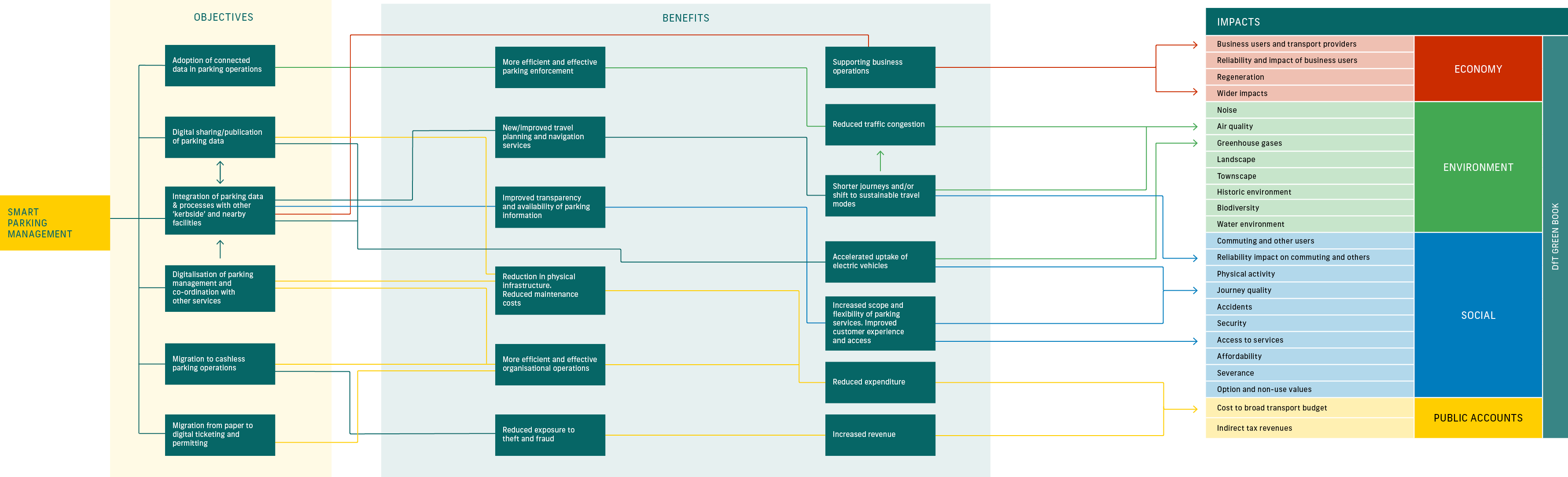
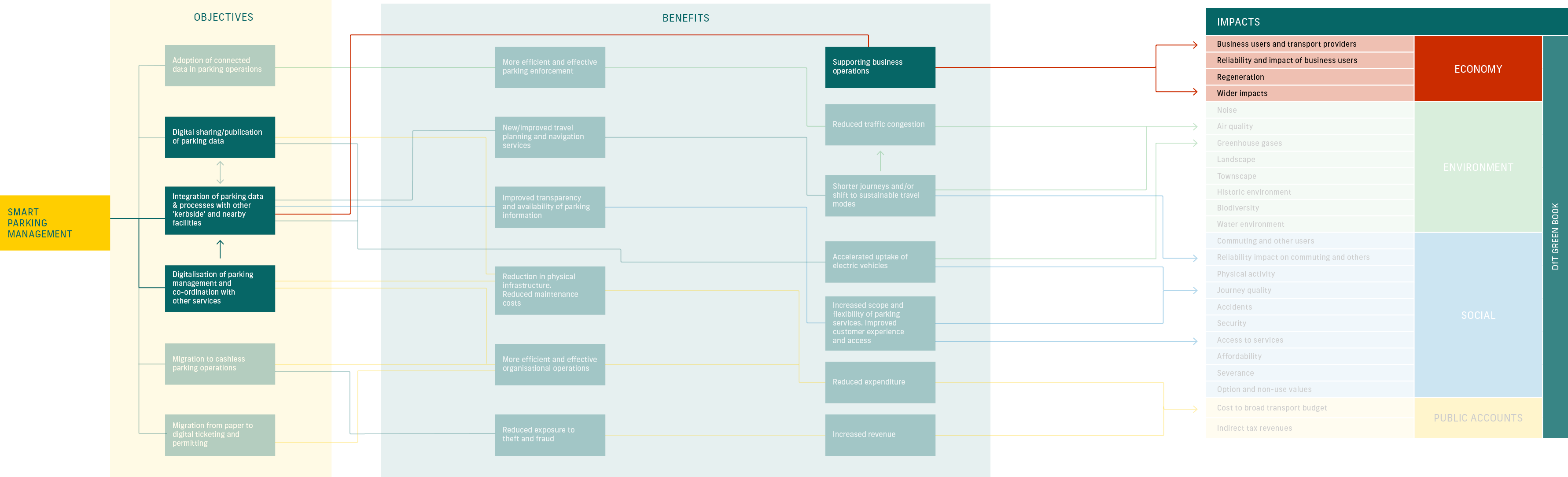
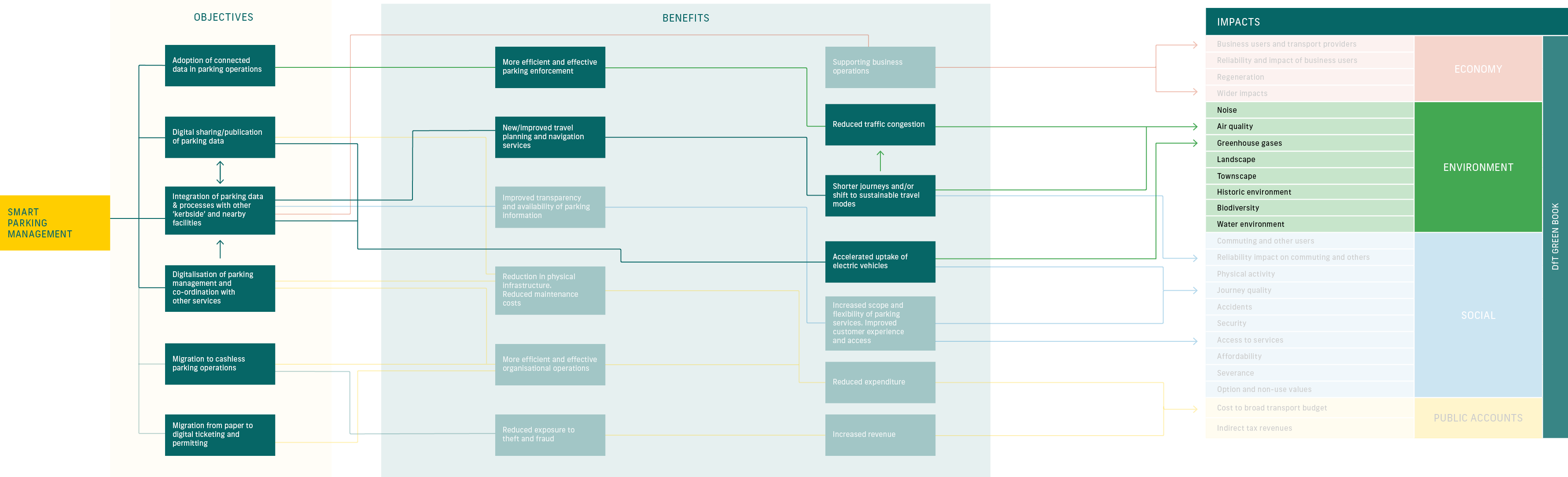
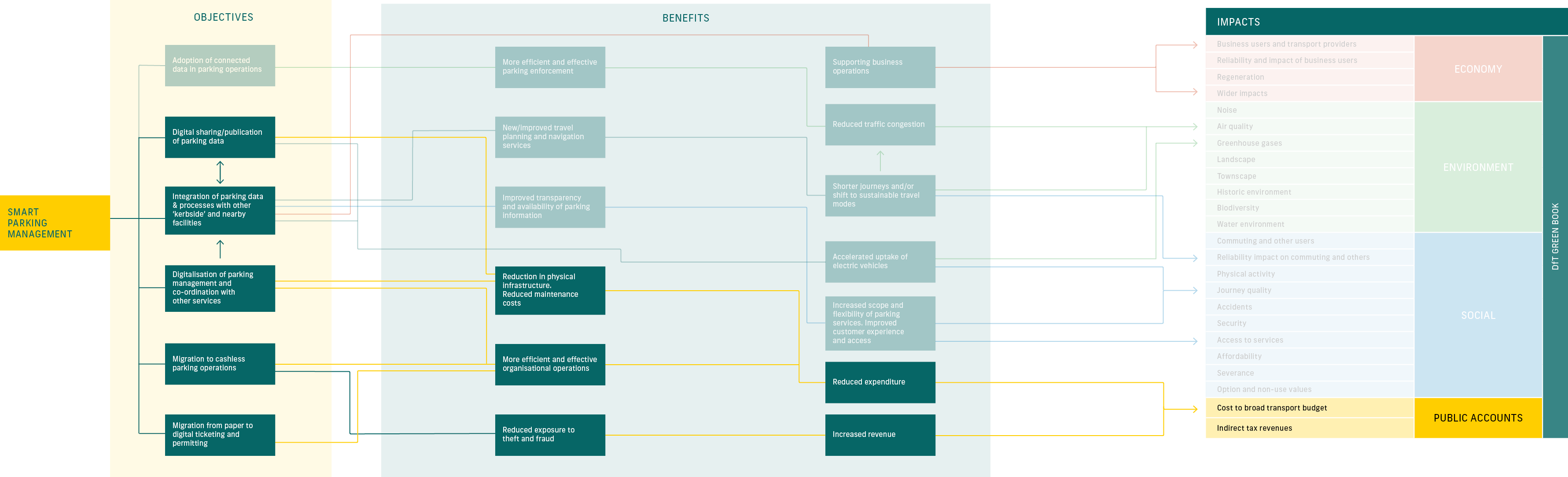
The potential impacts of the Parking Management Service are illustrated by the logic map shown in Figure 1 below.
Figure 1 – Parking information management service impacts Logic Map
View by impact type:

DRAG
Introduction
This section intends to support the development of plans and specifications by providing the following information:
- Actors: who need to be considered in the development of the system.
- Architecture and Data flows: showing how administrators and users interact and use the system, to help identify and develop the needs and specifications of the system.
- Standards: that are important and how these are used in the context of this use case.
- Possible future developments: in practices and technology that may provide opportunities in the future.
Actors
The service design is described by the interaction between the service and the actors (any user or system that interacts with the service).
The following actors need to be considered in the development of the service design:
- Parking User: the users of the service, who interact with the service to find, use and pay for parking.
- Parking Manager: the organisation providing the parking facilities/services, who carry out monitoring and management activities on the service and ensures that the data provided to the is up to date and accurate.
- Third-Party providers: some elements of the service may be provided by third-party service providers and may include parking payment solution providers, enforcement entities and information service providers for connected vehicle and mobility services. Interfaces to these service providers will be required and will depend on the local service design.
The journey of the driver through their interaction with the system is the focus of this Use Case and key to the description of the service. The Use Case does not describe the processes that a Local Authority will have to go through to develop parking policy, plans and operational strategies.
Architecture and Data Flows
The parking journey illustrated is considered from the perspective of the vehicle driver. Similar activities may be relevant to fleet managers. Only parking transaction activities are likely to be applicable to other actors such as residents, retail premises and businesses.
The data flows are illustrated in Figure 2 – Idealised Parking User Journey for Parking and Figure 4 – Idealised Parking Management Service Architecture from the System Manager’s perspective.
The data requirements and data flows are tabulated in Figure 3 – Data Requirements for Idealised User Journey for Parking and Figure 5 – Data Requirements for Idealised Parking Manager / Administrator Activities.
Figure 2 – Idealised Parking User Journey for Parking
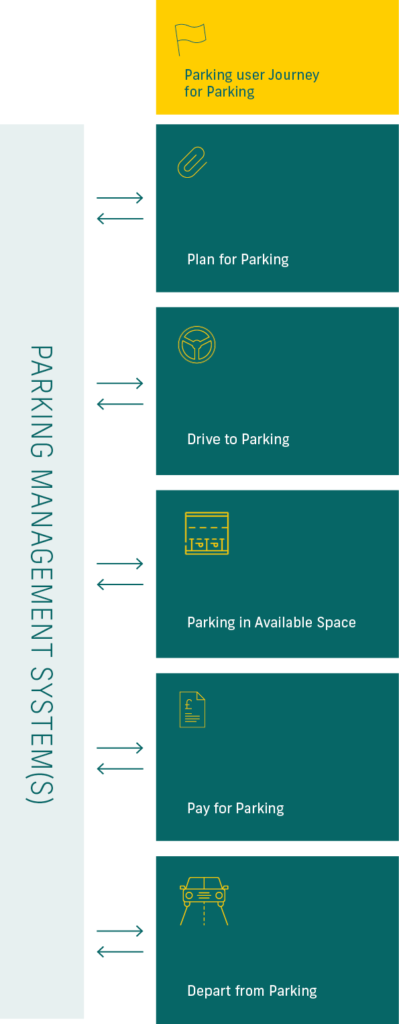
Figure 3 – Data Requirements for Idealised User Journey for Parking


Start
Plan for Parking
Drive to Parking
Park in available space
Pay for Parking
Depart from Parking

What the user needs
- As a user, I need to know the best parking options for my journey (based on preferences such as the route, availability, cost, accessibility), so that I can make an informed decision for the option I choose.
- As a user, I need to know my route to the parking and whether there are any changes to availability of parking spaces, so that I can start my journey and decide whether changes that require re-routing in order to arrive in a timely manner.
- As a user, I need to know if have arrived at the right parking space, so that I receive the correct services being offered and I am also legally parked so the correct payment will be taken (later).
- As a user, I need to know how much it cost (flat rate/incremental) to park and how I can pay for it, so that I can make the right payment to use the service.
- As a user, I need to know where I have parked my car and I have made the payment, so that I can successfully depart from parking.
What the system needs from the user
- Confirm start location and end destination
- Confirm (likely) duration of stay
- Confirm service level required (valet parking, disabled parking, family, EV, etc.)
- Confirm vehicle specifications
- Confirm user’s parking activity (basic parking, ride sharing, delivery, loading, unloading, etc.)
- Confirm user’s journey progress to parking
- Confirm the user’s vehicle has entered the car park
- Confirm the user has booked the parking space (for the vehicle)
- Confirm user’s vehicle has arrived at the right parking space
- Confirm the user’s vehicle has complied with any restrictions
- Confirm payment has been made
- Confirm the user has not ‘overstayed’
- Confirm user has complied with restrictions (e.g. use of ride-sharing bays)
- Confirm the user’s vehicle has left the car park
- Confirm the correct payment has been collected
Data requirements
- Car park descriptions including operational hours (overnight stay availability) and level of service provided (disability and EV charging)
- Location of parking spaces and their characteristics (space restrictions such as height, length, and width)
- Parking rates
- Real-time parking space availability
- Future parking space availability
- Historic parking space availability / utilisation
- Vehicle ID/specifications (dimensions, emission, etc.)
- Location for journey start / end destination
- Real-time parking space availability
- Future parking space availability
- Current vehicle location
- Location of (available / allocated) parking spaces
- Restrictions and events affecting route to parking
- Estimated travel time
- Vehicle ID / specifications (dimensions, emission, etc.)
- Current vehicle location (relative to parking space)
- Information on violation of any restrictions (disabled or
- EV charging bays)
- Duration of stay required
- Parking rates (amount to pay)
- Duration of stay
- Reference between payment and vehicle ID / specifications
- Payment options (when and how to pay)
- Personal or organisation (in case of fleets) payment information
- Personal address / contact details
- Provided level of service
- Information on violation of any restrictions (disabled or EV charging bays)
- Actual parking duration
- Payment data (amount collected for reference between payment and vehicle ID / specifications)
DRAG
Figure 5 – Data Requirements for Idealised Parking Manager / Administrator Activities


Start
Monitor physical assets
Maintain digital assets
Maintain / manage traffic management
Manage payment process
Manage enforcement process
Accounting and support activities
What the parking manager / administrator needs
- Up to date view of the physical assets including car parks availability
- Ensure physical assets are operational and maintained (based on reactive and predictive maintenance requirements)
- Ensure digital assets are available and maintained so that they reflect the state of the physical assets. This includes the locations of parking infrastructure and their characteristics.
- Ensure smooth traffic in and out of car park
- Ensure the payment system can cope with demand
- Ensure traceability of payments (including ones through 3rd party systems)
- Ability to identify issues in the payment system
- Make informed revenue decisions (e.g. change rates)
- Monitor performance against KPIs
- Have required evidence to support contravention decisions
- Have the ability to review, validate and address customers’ complaints
- Ensure the right payment has been taken
- Have the ability to refund payments
What the system needs from the manager
- Define and update information of the parking infrastructure to be monitored
- Define thresholds and criteria for raising flags
- Define and owner and operator of the car park (provide contact details of relevant responsible users, the contractors)
- Define and update performance indicators
- Define criteria and thresholds for raising flags
- Provide contact details of relevant responsible users (IT)
- Report on changes to physical assets
- Define traffic management actions (e.g. signal timing)
- Define information to send to car park users
- Define and update tariffs (e.g. dynamic pricing)
- Define and update tariffs
- Define parking restrictions in terms of time and space
- Define decisions about disputes and complaints
Data requirements
- Desired state of each asset (e.g. required lighting level)
- Condition of assets
- Location of assets
- Operator responsible for each asset
- Car park availability (real-time)
- Condition of assets
- Location of car parks
- Car park information (type, size, accessibility, and costs)
- Equipment availability and performance (e.g. sensors)
- Planned maintenance that has impact on parking availability / accessibility
- Traffic and parking demand data (e.g. upcoming events, status of other car parks)
- Real-time traffic levels near car park
- Historic traffic levels near car park
- Traffic levels within car park
- Historic revenue data at required level (annual, monthly, daily, …)
- Payment system performance data
- Payment options and routes data
- Information from the parking guidance
- Car park descriptions including operational hours (overnight stay availability) and level of service provided (disability and EV charging)
- Location of parking spaces and their characteristics (space restrictions such as height, length, and width)
- Parking rates
- Payment system performance
- Information from enforcement management
- User transaction data
- User contact details
DRAG
Interfaces
Interfaces between systems and services will depend on the specific design and the boundaries with other systems and services.
The general principle is that standardised data flows should be used wherever standards are available to support the integration of parking information services.
Standards
The Alliance for Parking Data Standards (ADPS) has developed data specifications for parking and kerbside management. Providing a common language for data concepts and definitions of parking data, and API definitions for an APDS-compliant service. These reduce the effort required to connect technology solutions to each other and allow entities to focus their resources on innovating new services and operations. A common API enables roaming of information and transaction data, providing a seamless service for end-users without the need for multiple apps. ADPS have adopted a consensus-built approach and the standards have recently been adopted by The International Organization for Standardization to form the basis of a forthcoming ISO standard for a parking core data model (ISO/DTS 5206-1, planned Spring 2022). Furthermore, the standard is being considered for a revision to the DATEX II parking publications data content standard (CEN/TS 16157-6)
In the UK, the Department for Transport and Manchester City Council are undertaking the National Parking Platform Project, creating a platform based on the ADPS standards. The platform will provide a range of nationwide data services for parking, including data on parking locations, tariffs, occupancy and payment services. Making parking data available to the customer via third-party apps. Car parks and on-street parking areas supplying data to the National Parking Platform will have enhanced “digital visibility” giving them an important commercial and competitive advantage. On-street Authorities will be able to increase the efficiency of their operations, provide a better service and reduce the cost of compliance management.
The digitalisation of Traffic Regulation Orders (TROs) has been under development since 2018. Early work highlighted that 400 Authorities across Great Britain create an estimated 53,300 TROs annually at a projected cost of £126.4 million. Identifying value is in making the data shareable, machine-readable and to a consistent standard. In 2019, a draft data model user guidance for TROs was published. A project to develop a product that allowed TRO makers to access, input and publish TRO data in a common format for shared use has been considered and future projects could deliver standards and/or platforms for digital TROs.
It is important that service development aligns with and/or supports the development of national standards:
- To ensure the digitalised services consumed by customers is Authority agnostic and does not require different apps/services for different towns and cities.
- To ensure the services can interface with existing customer-facing accounts e.g. The National Parking Platform, Google, Apple, OEM -based services.
Possible Future Developments
Parking is a rapidly developing area that benefits from a range of emerging technologies. The following list identifies products and services that are under development or already available in the market.
- Smart payment services and links with Licence Plate Recognition cameras.
- Pay-by-Plate enables customers to pay for parking using automatic licence plate recognition cameras and a mobile app or online account with no payment needed directly at the point of entry or exit.
- The International Parking Information and Payments Standards (IPIPS) are the result of a European Parking Association (EPA) initiative. The first IPIPS published in September 2017 provides the standard specifications for the interface between parking equipment and card payment terminals. The IPIPS will facilitate interoperability between operators and equipment suppliers.
- Data analysis and tools are increasingly used to help Authorities understand operational information such as: travel pattern data, user demand profiles, parking utilisation, efficiency indicators, and congestion and capacity analysis.
- Centralised parking information databases that connect all driver information within a geographic area, integration with third party systems, parking machines, cashless options, pollution forecasts, permits and enforcement data, allow Authorities to make real-time adjustments to optimise and manage traffic flows. Average dwell times and price sensitivities can be analysed to deliver the efficient and fair management of traffic flows across the network. For example, AppyWay has helped Dorset Council to visualise complex real-time traffic order data including active on-street restrictions. Helping to manage both static and moving traffic orders to make traffic order management faster and more efficient.
- On-demand management dashboards allow Authorities to monitor parking behaviour and utilisation to provide effective cost control, information management, reliable auditing and improved decision making.
- For cities struggling with pollution and poor air quality, pollution-based parking fees have emerged as a way to encourage cleaner cars and improve air quality. Parking fees/discounts are applied based on a vehicle’s emission characteristics. For example, RingGo’s emission-based and net-zero parking solution uses a vehicle’s registration details, combined with information from the DVLA to automatically vary parking tariffs based on the vehicle’s emissions class.
- The National Parking Platform (NPP) is a major, publicly owned initiative funded by DfT and hosted by Manchester City Council. It is open to public and private parking operators and service providers.
- The NPP will improve the customer journey across the full range of on-street and off-street parking (both public and private) via a publicly owned platform. Drivers are able to locate suitable parking at their destination, check tariff and availability, pre-book a space and make payment through the NPP, before starting their journey or modify their journey as conditions change to use alternative parking.
- Improved smart parking infrastructure such as connected/automated technology (in-vehicle dashboard or mobile apps) and advanced real-time vehicle parking sensor solutions (smart car counters and signs) can combine to provide a better user journey:
- Sensors can provide real-time occupancy data and publish to apps, helping users navigate to car parks with spaces.
- Location sensors or technologies can be used to identify the parking location and make the appropriate automatically.
- With location services enabled, the Location ID may be displayed on the driver’s navigation system or on signage in the car park to help direct them to the correct bay.
- A push notification can notify the driver when their parking session is about to expire and provide them with options to extend their booking if needed.
- In suitable locations, a parking app can direct users to free, on-street parking.
- Self-ticketing services, (e.g. provided by UK car park management) empower a crowdsourced contribution to enforcement, to help manage parking issues.
- KerbUK has developed a solution to manage kerb space effectively using virtual loading bays. These are guaranteed, time-specific, kerb slots for delivery vehicles to be sure of a parking or unloading location at their destination. Parking/unloading permissions are granted at a time that least impacts traffic flow and emissions.