Latest update: 21 April 2023
Electric Vehicle Charging


Electric Vehicle (EV) charging information and management services support drivers in finding and paying for suitable EV charge points by providing real-time availability and accessibility information. These services support Authorities in planning, promoting, monitoring, and maintaining EV charge points and managing compliance.

In November 2020 the UK Government announced that the phase-out date for the sale of new petrol and diesel cars and vans will be brought forward to 2030, with all new cars and vans to be fully zero emission at the tailpipe from 2035. A capable and accessible electric vehicle charging network is essential to support this transition to low carbon emissions transport across the UK.

EV charging infrastructure is being rapidly installed across the UK, and the rate of deployment must accelerate to meet the above goals. As EV products and services are developed they are increasing in capabilities, and furthermore in several dimensions of complexity including technical, supply chain, and support systems. This places an increasing demand on EV charging infrastructure to be linked to information services to make them more visible (their location and availability), accessible, and maintainable.

The business models for EV manufacturers and service providers vary with some providing a relatively complete set of services and facilities under the control of a single organisation (e.g., Tesla) and others using an ecosystem of several businesses to provide customer services. Presently a significant proportion of EV charging customer journeys are supported by digital services and facilitated by a relatively complex business ecosystem. The ecosystem is heavily reliant on EV charging management systems and connectivity services, and communication issues (especially outages) usually create disruption and inconvenience for users.

This Use Case focuses on EV charging management services that are associated with public on-street charging facilities. However, areas of the content may be applicable to private and/or off-street charging facilities.

The management and use of EV charging are supported by real-time data and good connectivity including:

  • Finding suitable charging points and checking their availability, system compatibility, charge rate, and in some cases; booking a charging time slot (e.g. Zap-Map ).
  • Route planning and navigation services (especially for longer journeys), for example, through mobile navigation logistics or Fleet Management and route planning apps, (including Trakm8, TomTom Go, HERE WeGo, Sygic).
  • Performing payment pre-authorisation to unlock the EV charging point equipment for use.
  • Receiving notifications that charging has been completed.
  • Information exchange between charging/parking operators and service providers to facilitate customer roaming.


Using and sharing EV charging management data presents several challenges including:

  • General lack of available public open data for EV charging points is one of the key challenges to enabling consumers to easily locate charge points suitable for their needs. Therefore, open data is essential to supporting innovation in the sector and provide services to EV users.
  • Range anxiety can reduce the uptake of EVs. The visibility of suitable charging locations including charging capacity and compatibility information can improve the perception of EVs as a viable solution.
  • For journeys beyond the range of their battery, EV users will want to plan the route to incorporate charging locations.
  • Charge point technology is evolving, with different connections, charging speeds and payment options, as a result ways for drivers to find facilities that meet their specific requirements are required.
  • Charge point technology is commercialised to different extents depending on location and investment, and is located in distributed locations around the road network. This presents challenges to maintenance operations and ensuring high equipment availability.
  • Charging demands may influence electricity pricing. Clear accounting and demand prediction may be required to manage costs and services through the life of the installation
  • A rapid increase in EV charging will place new and substantial demands on the electricity grid. By scheduling charging, the network demand can be managed to spread the peak.
  • In the long term, EV charging services must be a sustainable business funded by customers. However, in the short term services are often promoted or subsidised by Authorities to accelerate the uptake of EVs in order to meet sustainability targets.

High-level objectives

EV Charging Services support the achievement of some or all of the following objectives:

  • Improve the user experience and ease of access to information in one place, and access to facilities
  • Integration of EV charging data and processes with kerbside and nearby facilities. Enabling better, more holistic, connected services for drivers/customers helping to connect them to their desired needs and making better use of existing facilities.
  • Supports coordinated and efficient management and delivery of services with reduced manual or duplicated activities.
  • Builds resilience of services through implementation of best practices and architectures to reduce impact of single point of failures.
  • Accelerate the uptake of electric vehicles and develop the UK market for manufacturing of charging infrastructure.
  • Availability of charging infrastructure to support the adoption of electric cars.
  • Capacity to target replacement of high polluting vehicles that negatively impact on local air quality, due to zero emissions alternatives being more accessible.


Policies potentially supported by the service

The EV Charging Information Services can support the following policies:

  • Transport information services
  • Data digitalisation
  • Asset management
  • Road safety
  • Land use planning
  • Services for disabled and vulnerable road users
  • Electric vehicle charging
  • Mobility on demand
  • Decarbonisation of the transport fleet
  • Improvement of air quality and reducing noise
  • Industrial Strategy – opportunities for a UK based electric vehicles manufacturing sector

Qualitative Benefits

EV Charging Information Services support the following benefits:

For EV Drivers

  • Improved transparency and availability of EV charging information
    • – Making EV charging parking information available to users, either directly or via third parties


For Authorities

  • Improved transparency and availability of EV charging information
    • – Better collection of data on EV utilisation for monitoring and evaluation
  • More efficient and effective EV charging parking enforcement
    • – Improve the trust of users to overcome range anxiety and increase reliability of the charging network
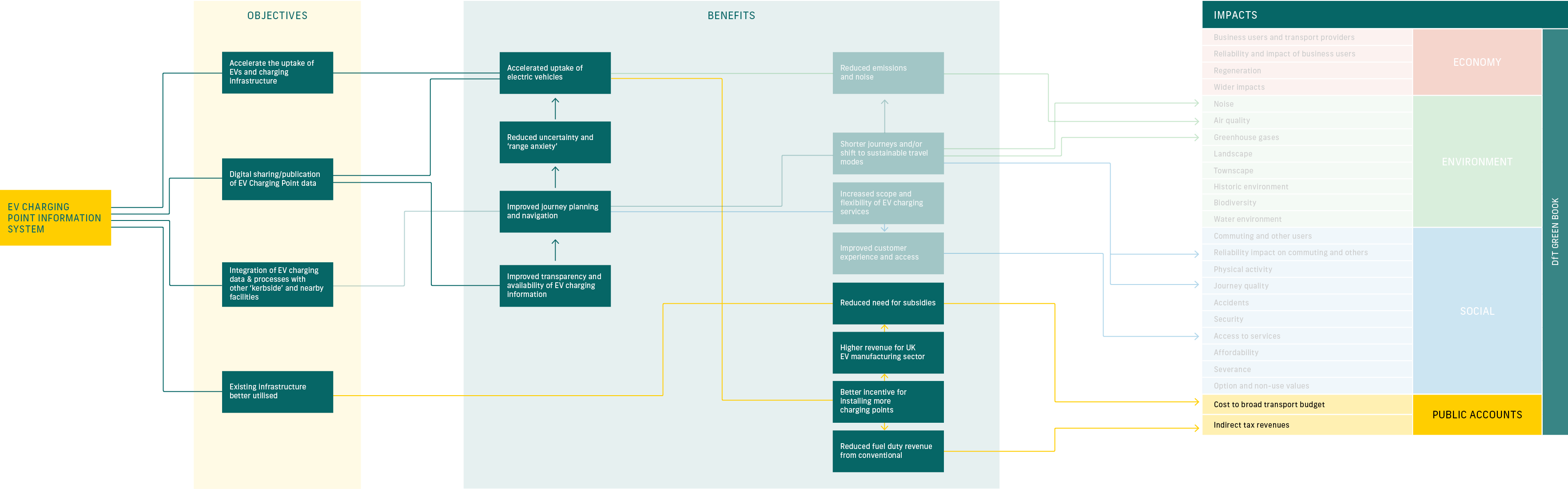
  • Accelerate uptake of electric vehicles
    • – Providing information on charging facilities as part of digital parking information services, helps to overcome barriers to use of electric vehicles which promotes their use and ownership


Quantitative Benefits

The EV Charging Information Service can support the following benefits:

  • Air quality improvement
  • Reduced traffic congestion
    • – Improved digital services enable access to better travel planning and guidance about EV charging facilities which reduces journey time and times and stress on congested roads.


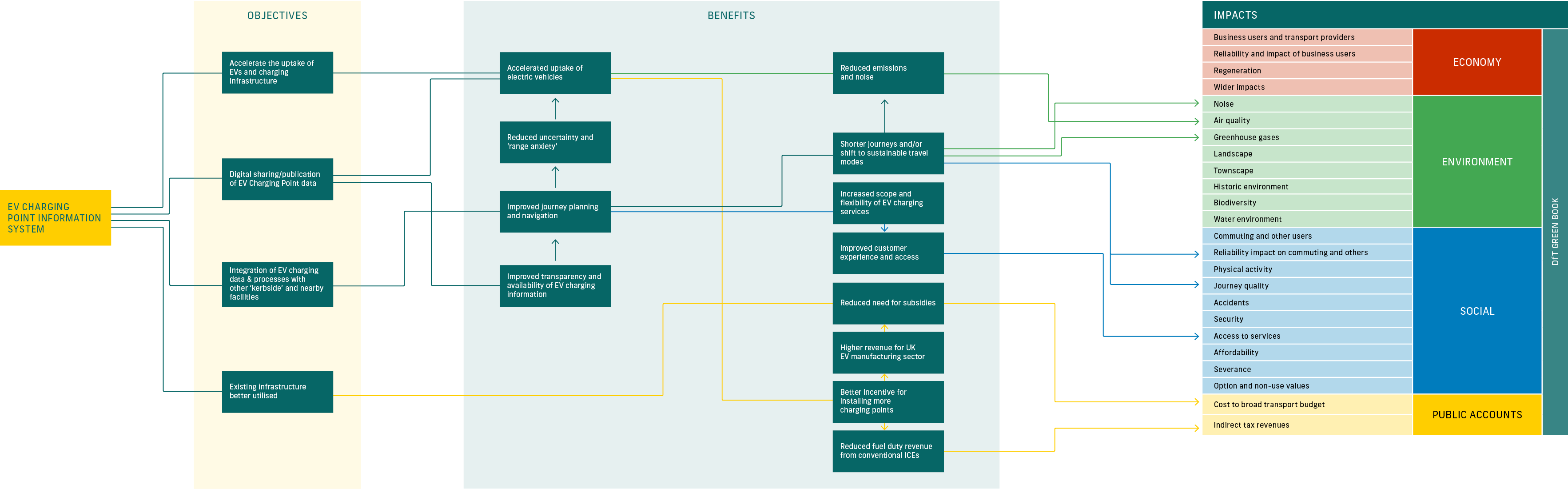
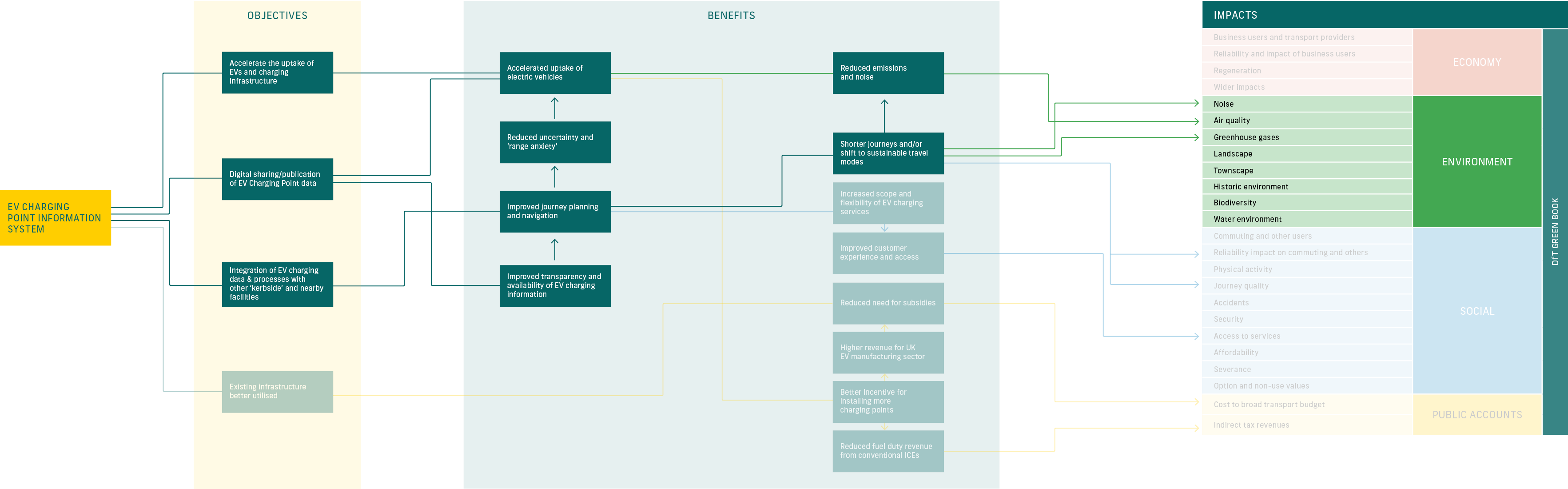
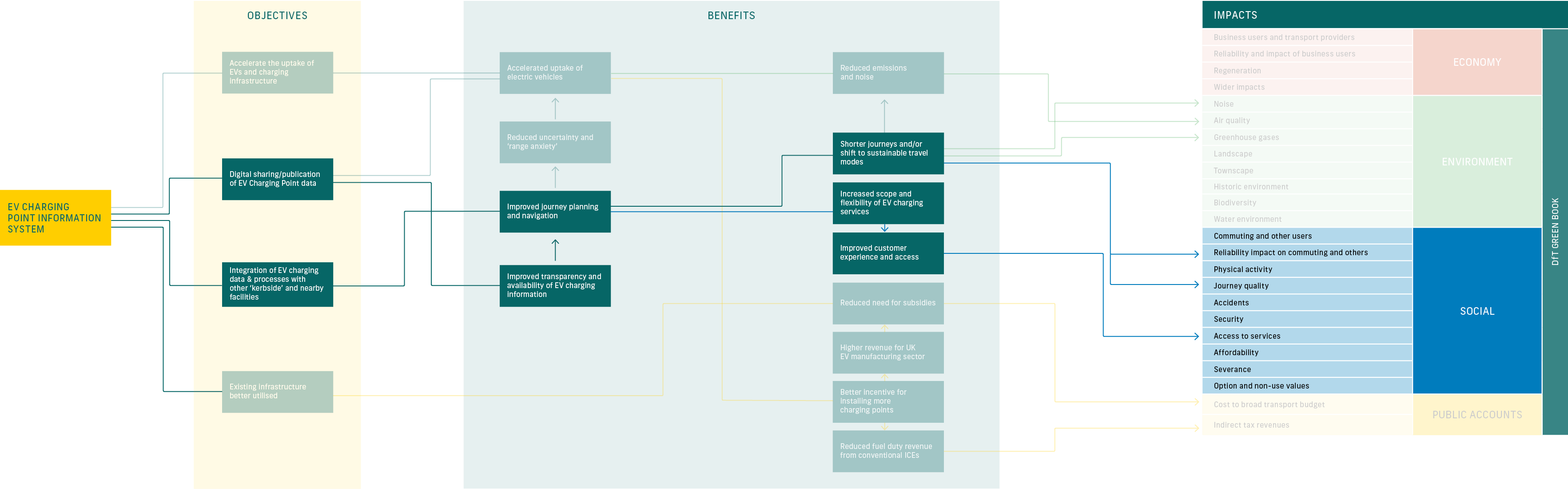
Figure 2 – The potential impacts of the EV Charging Information Service


View by impact type:

DRAG

Introduction

This section supports the development of plans and specifications by providing the following information:

  • Actors: who need to be considered in the development of the system.
  • Architecture and Data flows: showing how administrators and users interact and use the system, to help identify and develop the needs and specifications of the system.
  • Standards: that are important and how these are used in the context of this use case.
  • Possible developments in practices and technology that may provide opportunities in the future.


Actors

The key is the interaction between the service and the actors (any user or system that interacts with the service). The following actors need to be considered in the service design:

  • EV Drivers – Members of the public, or businesses, who benefit from EV charging data to smooth their interaction with the service (e.g. help them identify, find, pay for and use EV charging points).
  • Local Residents – People residing in the administrative area of the Authority who requires access to charge points on a regular basis and need to be considered during the planning of locations of charging points.
  • Authorities – Organisations with responsibilities for managing traffic and street services. This includes managing planning permissions for on-street charging points, planning and promoting the rollout of charging facilities to support policy goals and integrating on-street charge point infrastructure with other street services including parking operations.
  • Chargeing Point Operators – These ensure the day-to-day running of the EV charging infrastructure and digital platforms. They may provide reporting of KPIs such as utilisation and uptime to the Authority or present them with a dashboard.
  • E-mobility service providers – This includes third party systems from companies such as Zap-Map and Digital Charging Solutions, which provide a platform for EV drivers to search for charging points, plan longer journeys, pay on participating networks, and share updates with other EV drivers. Some components of the idealised service may be provided by other third-party service providers, and in this case, API interfaces to those service providers will be required. The exact requirement for interfaces will depend on the specific local service design.


From the perspective of this Use Case, the journey of the EV driver through their interaction with the system has been focused on for the description of the service. The Use Case does not describe the processes that an Authority would have to go through to develop fully a EV management system, or suitable EV policy, plans and operational strategies, or put in place contracts and other aspects that will have to be implemented to deliver the overall service.


Architecture and Data Flows

For the purpose of the information and diagram presented here, an EV charging journey is considered as one journey from A to B using a pre-booked charging point. However, in reality, the planned journey may change due to multiple reasons such as changes to the traffic network, weather conditions, availability of the charging point, etc. Changes may also occur when new charging point options are presented to the driver based on their journey.

The EV charging management system is likely to be comprised of many component solutions from a different suppliers. To enable these to run cohesively, standards will need to be defined to support communication between service components and an integration process will be required.

The data flows are illustrated in Figure 2 – Idealised Journey for EV Drivers and Idealised EV Charging Service Architecture from a Manager’s perspective.

The data requirements and data flows are tabulated in Figure 3 – Data Requirements for Idealised Journey for EV Driver and Figure 5 – Data Requirements for Idealised EV Manager/Administrator Activities.
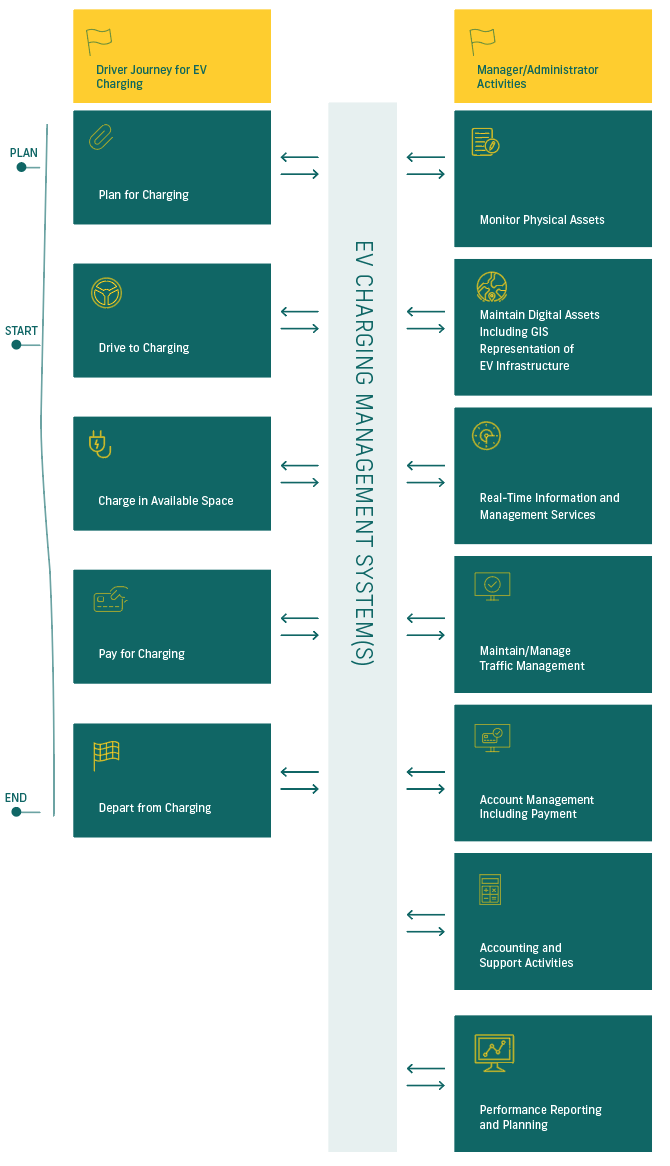


Figure 3 – Data Requirements for Idealised Journey for EV Driver


Start


Plan for Charging


Drive to Charging


Charge in available space


Pay for Charging


Depart from Charging

What the EV driver needs

  • As a user, I need to know the best EV charging point options for my journey based on preferences (route, time availability, cost, accessibility) and requirements (connector, compatibility, charge level), so that I can make an informed decision for the option I choose.
  • As a user, I need to know my route to the EV charging point and whether there are any changes (to booking, network performance and service level), so that I can start my journey and decide whether changes that require re-routing in order to arrive in a timely manner.
  • As a user, I need to know if I have arrived at the right EV charging point, so that I receive the correct services being offered and I am also legally parked if it’s linked to a parking payment.
  • As a user, I need to know how much it cost to charge my vehicle and how I can pay for it, so that I can make the right payment to use the charging service.
  • As a user, I need to know where I have charged my vehicle and I have made the payment, so that I can successfully depart from the facility.

What the system needs from the EV driver

  • Confirm start location and end destination
  • Confirm required duration of stay
  • Confirm vehicle specifications
  • Confirm service level required (just charge, (disabled access) parking and charge, etc.)
  • Confirm user’s journey progress to charging point
  • Future consideration – current vehicle state of charge (to see if an earlier charger is required due to unforeseen congestion or uphill legs)
  • Confirm the user’s vehicle has entered the charging location and ‘plugged in’
  • If booked. confirm the user has parked the vehicle in the right space
  • Confirm user’s vehicle has arrived at the right charging point/service
  • Confirm the user’s vehicle has complied with any restrictions
  • Confirm payment has been made
  • Confirm the user has not ‘overstayed’ if linked to a parking payment
  • Confirm user has complied with restrictions if linked to a parking payment
  • Confirm the user’s vehicle has disconnected and left the charging point
  • Confirm the correct payment has been collected

Data requirements

  • Charging type descriptions including operational hours (overnight stay availability) and level of service provided (charger type, disabled)
  • Location of charging spaces and their characteristics (space restrictions such as height, length, and width)
  • Charging price schedule
  • Real-time charging space availability
  • Future charging space availability
  • Historic charging space
  • availability / utilisation
    Vehicle ID/specifications (dimensions, charging requirements – type of accepted charge, socket type, wireless charging capability, etc.)
  • Location for journey start / end destination
  • Real-time charging space availability
  • Future charging space availability
  • Current vehicle location
  • Location of (available / allocated) charging spaces
  • Restrictions and events affecting route to charging point
  • Estimated travel time
  • Vehicle ID / specifications (dimensions, charging requirements – type of accepted charge, socket type, wireless charging capability, etc.)
  • Information on violation of any restrictions (disabled)
  • Current vehicle location (relative to charging space)
  • Duration of stay required
  • Amount of charge used by the vehicle
  • Charging price schedule (amount to pay)
  • Duration of stay
  • Amount of charge used by the vehicle
  • Amount to pay
  • Reference between payment and vehicle ID / specifications
  • Payment options (when and how to pay)
  • Personal or organisation (in case of fleets) payment information
  • Personal address / contact details
  • Provided level of service – linkage to any parking payment
  • Information on violation of any restrictions – linkage to any parking (disabled)
  • Actual charging duration and charge provided
  • Payment data (amount collected for reference between payment and vehicle ID / specifications)
DRAG

Figure 5 – Data Requirements for Idealised EV Manager/Administrator Activities


Start


Monitor Physical Assets


Maintain Digital Assets


Real-time Information and Management Services


Maintain/Manage Traffic Management


Account Management including Payment


Accounting and Support Activities


Performance Reporting and Planning

What the manager / administrator needs

  • Up to date view of the status of the physical assets including charging point availability
  • Ensure physical assets are operational and maintained (based on reactive and predictive maintenance requirements)
  • Ensure effective electric grid connection management to cope with demand
  • Ensure digital assets are available and maintained so that they reflect the state of the physical assets. This includes charging point locations, operational hour and charge type.
  • Ability to flag any immediate issues that need intervention. a
  • Ensure up-to-date availability of real time information provided to EV users. This includes EV charging point status.
  • Ensure smooth traffic “near” EV charging points
  • Ability to optimise network to improve EV charging services
  • Ability to efficiently respond to disruption. This includes planning of alternative options and communicate this to EV charging users
  • Ensure the payment system can cope with demand
  • Ensure traceability of payments (including ones through 3rd party systems)
  • Ability to identify issues in the payment system (e.g. faulty card readers)
  • Make informed revenue decisions (e.g. change pricing for charge rates)
  • Have the ability to review, validate and address customers’ complaints
  • Ensure the right payment has been taken
  • Have ability to refund payments
  • Ensure EV operators maintain KPIs of the operations.
  • Understand EV service performance and identify opportunities for future investments for strategic rollout.
  • This includes analysing changes in patterns of travel, access (disabled access KPI), charging behaviour

What the system needs from the manager / Administrator

  • Define and update information of the physical EV infrastructure to be monitored
  • Define thresholds and criteria for raising flags
  • Define the owner and operator of the charge point
  • Provide contact details of relevant responsible users, the contractors
  • Define and update performance indicators
  • Define criteria and thresholds for raising flags
  • Provide contact details of relevant responsible users (IT)
  • Report changes to physical assets
  • Confirm EV location
  • Confirm actions in response to changes in status of the network. This includes alternative routes and EV charging point options
  • Define traffic management actions (e.g. signal timing)
  • Define information to send to charge point users
  • Defined tariffs (e.g. dynamic pricing)
  • Decisions about complaints
  • Define and update performance indicators
  • Define criteria and thresholds for raising flags
  • EV charge point planning regulation

Data requirements

  • Desired state of each asset (including KPIs for uptime)
  • Current state of assets including EV charge point locations and conditions
  • Operator’s responsible for each asset
  • Planned maintenance that has an impact on charging availability/accessibility
  • Estimated time left for charge
  • Traffic and charging demand data (including dwell time data)
  • Current traffic levels and types
  • Historic traffic levels and types
  • Historic revenue data at required level (annual, monthly, daily, …)
  • Payment system performance data
  • Payment options and routes data
  • User journey data
  • User charge data
  • Active card checks
  • Payment system performance
  • User account data
  • User journey data
  • User payment transaction data
  • User contact details
  • User charging datas
  • Historic data of asset performance including utilisation of charging points
  • Historic data of users including behaviour, analysis on complaints and customer satisfaction
DRAG
Interfaces

Interfaces between systems and services will depend on the specific design and the boundaries with other systems (regional, international) and services.

The principle is that interfaces should be specified to use standardised data flows wherever standards are available, in order to support integration.


Standards

The Open Charge Point Interface (OCPI)  is an established open protocol for exchanging information about charge points between charge point operators and e-mobility service providers. The protocol provides a wide set of functionalities that enables scalable and automated EV roaming between Charge Point Operators. This includes: reservation, authorisation, billing and charging session management. EV Roam is the UK’s ID registration organisation, maintaining a central registry of known e-Mobility Service Providers and Charge Point Operators that interoperate with OCPI. Their website shows the full list of organisations currently registered.

If charge point operators support EV roaming through standards such as OCPI then their charge points are likely to be better utilised due to their being discoverable and accessible through a wider set of service providers rather than being limited to subscribers of a single operator or service provider. Registration could be independently verified by checking if their existing facilities are listed and accessible on 3rd party service providers such as zap-map or digital charging solutions.

The OCPI protocol functionality includes static charge point information (e.g. location, type) and real-time status information (e.g. available, blocked, charging, reserved). Subscribing to this data could be of direct relevance for Authorities to help to maintain records of current charge point assets which would support planning activities; and/or determine real-time status information to support operations such as parking management.

The association for renewable energy and clean technology has published A guide on electric vehicle charging and DNO engagement for local authorities. The guide is intended for Local Authorities wishing to buy and install EV charge points and provides high-level guidance on charge point specification and the process of installing and connecting them with a particular focus on the engagement of the district network operator providing the electrical infrastructure.

Other relevant standards for electric vehicle charging include:

  • Open Charge Point Protocol, for communication between electric vehicle charging stations and the operator’s central management system. Therefore providing interoperability between charge point equipment and charging network operators.
  • Open Smart Charging Protocol, for communication between the local electricity grid and charge point operators to facilitate capacity based smart charging.
  • Open Clearing House Protocol, Open InterCharge Protocol and eMobility Interoperation Protocol: enable communications and information exchange between operators and service providers to enable roaming to electric car drivers.
  • ISO 15118: an international set of standards for communications between EVs and charging stations that enables plug and charge capabilities.


Possible Future Development

EV charging information services are likely to benefit from a range of emerging technologies, some of which are already being tested and trialled to make journey planning and payment simpler and more seamless:

  • Smart charging can enable better use of network assets by shifting demand away from peak periods.
    • – It can also help to make best use of renewable power by managing charging to co0incide with times of peak production.
    • – A further potential benefit comes from EVs exporting electricity to the grid (V2G), the home (V2H) or buildings (V2B) such as business premises, during periods of high demand or low electricity supply. Such an approach enables EVs to act as mini local power plants.
  • Supporting the smart use of open data for new apps is key to accelerating digitalisation and decarbonisation:
    • – Open data provided to users will help drivers easily locate and use affordable, reliable charge points. This will support the move away from the use of fuel-based vehicles and encourage the shift in user behaviour through a reduction in pain points (e.g. range anxiety, improved booking and payment experience).
    • – Comprehensive charge point data and OD data are crucial for mapping charging hotspots and notspots for consumers, to help to support the business cases, future public transport planning and EV charging point strategic rollout. A consideration of EV charging strategy is to ensure that it is not competing with other sustainable modes e.g. chargers where a bike lane or bus lane could be or putting in chargers where pedestrianisation is an option. Dynamic pricing can be implemented, reflecting data about how drivers plan their journey and analysis into dwell time and price sensitivity based on location and time.
    • – The Government established the National Chargepoint Registry in 2011, an open-source of data for public charge points. However, only publicly funded charge points are required to register. The Government is looking to make information on all public charge points openly available in a standard format. Information including locations, power ratings and charge points status would be included. The Department for Transport (DfT) is investigation how this real-time information could be published and then used by developers and incorporated into sat navs and route mapping apps.
  • The Electric Vehicle Energy Taskforce, has 21 proposals for transport electrification and interoperability:
    • – Extend the minimum technical requirements for smart chargers to facilitate the management of electricity network capacity by 2021.
    • – Ensure system resilience through the agreement of common standards for cyber security.
    • – Develop governance arrangements for the use of emergency charge limitation by a network company.
    • – Develop common labelling standards for EVSE.
    • – Recognise the need for a single asset register of public charge points, including information on location, type, status, capacity, price and availability.
    • – Encourage cooperation amongst industry players to develop comprehensive data sharing arrangements and open and interoperable exchange principles and mechanisms, in line with the implementation of recommendations made by the Energy Data Taskforce.
    • – Encourage public charge point owners, operators and market actors must make data on location, type, status, capacity, price and availability consistent and openly available to EV drivers.
    • – The Government and Ofgem should iIntroduce a Data Access and Privacy Framework for the EV sector.
  • Companies such as Zap-Map provide information including charging speeds, location and status of EV chargers across the UK, with Zap-Map recently adding voice command functionality through Google Assistant.
  • Provide a revenue stream / commercial return to Authority in addition to parking income if they adopt an “own and operate” model:
    • – Several Authorities have already delivered some EV charging infrastructure and according to the  EVSE procurement guide most Authorities are planning to be involved in the procurement or deployment of public EV charging infrastructure in the future.
    • – In this case, EV charging may need to be supported by resources including capital and revenue funding. The Office for Zero Emission Vehicles (OZEV) continues to develop the national rollout strategy for EV charging and define the role played by various Authorities.
  • This means supporting the structure of the contracts going forward and the cost of third parties for the supply of charging at those bays.
  • Supporting range and battery management for the fleet operators (e.g., refilling card replaced by integrated payment system to identify and attribute vehicle charging costs).