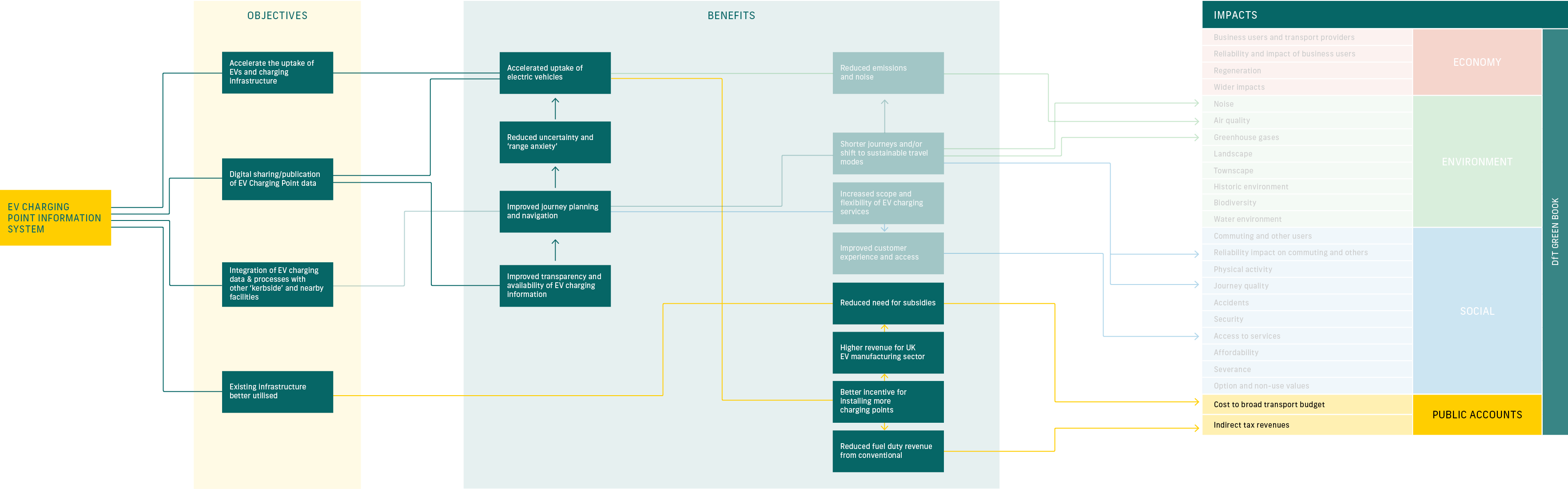
Introduction
This section supports the development of plans and specifications by providing the following information:
- Actors: who need to be considered in the development of the system.
- Architecture and Data flows: showing how administrators and users interact and use the system, to help identify and develop the needs and specifications of the system.
- Standards: that are important and how these are used in the context of this use case.
- Possible developments in practices and technology that may provide opportunities in the future.
Actors
The key is the interaction between the service and the actors (any user or system that interacts with the service). The following actors need to be considered in the service design:
- EV Drivers – Members of the public, or businesses, who benefit from EV charging data to smooth their interaction with the service (e.g. help them identify, find, pay for and use EV charging points).
- Local Residents – People residing in the administrative area of the Authority who requires access to charge points on a regular basis and need to be considered during the planning of locations of charging points.
- Authorities – Organisations with responsibilities for managing traffic and street services. This includes managing planning permissions for on-street charging points, planning and promoting the rollout of charging facilities to support policy goals and integrating on-street charge point infrastructure with other street services including parking operations.
- Chargeing Point Operators – These ensure the day-to-day running of the EV charging infrastructure and digital platforms. They may provide reporting of KPIs such as utilisation and uptime to the Authority or present them with a dashboard.
- E-mobility service providers – This includes third party systems from companies such as Zap-Map and Digital Charging Solutions, which provide a platform for EV drivers to search for charging points, plan longer journeys, pay on participating networks, and share updates with other EV drivers. Some components of the idealised service may be provided by other third-party service providers, and in this case, API interfaces to those service providers will be required. The exact requirement for interfaces will depend on the specific local service design.
From the perspective of this Use Case, the journey of the EV driver through their interaction with the system has been focused on for the description of the service. The Use Case does not describe the processes that an Authority would have to go through to develop fully a EV management system, or suitable EV policy, plans and operational strategies, or put in place contracts and other aspects that will have to be implemented to deliver the overall service.
Architecture and Data Flows
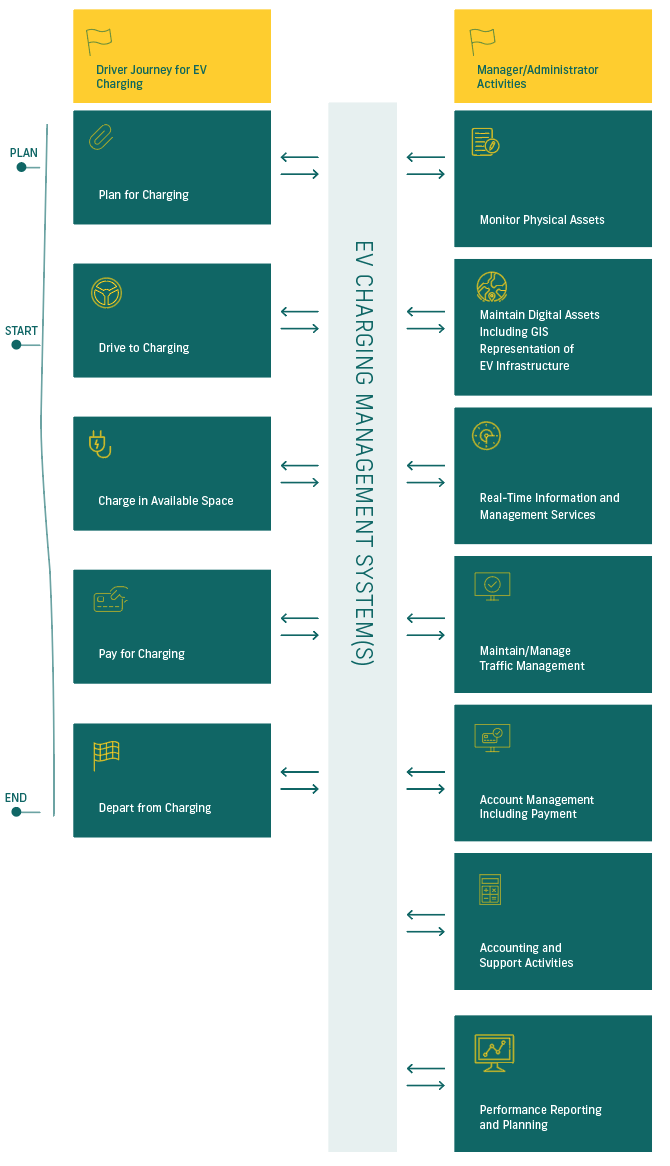
For the purpose of the information and diagram presented here, an EV charging journey is considered as one journey from A to B using a pre-booked charging point. However, in reality, the planned journey may change due to multiple reasons such as changes to the traffic network, weather conditions, availability of the charging point, etc. Changes may also occur when new charging point options are presented to the driver based on their journey.
The EV charging management system is likely to be comprised of many component solutions from a different suppliers. To enable these to run cohesively, standards will need to be defined to support communication between service components and an integration process will be required.
The data flows are illustrated in Figure 2 – Idealised Journey for EV Drivers and Idealised EV Charging Service Architecture from a Manager’s perspective.
The data requirements and data flows are tabulated in Figure 3 – Data Requirements for Idealised Journey for EV Driver and Figure 5 – Data Requirements for Idealised EV Manager/Administrator Activities.
Interfaces
Interfaces between systems and services will depend on the specific design and the boundaries with other systems (regional, international) and services.
The principle is that interfaces should be specified to use standardised data flows wherever standards are available, in order to support integration.
Standards
The Open Charge Point Interface (OCPI) is an established open protocol for exchanging information about charge points between charge point operators and e-mobility service providers. The protocol provides a wide set of functionalities that enables scalable and automated EV roaming between Charge Point Operators. This includes: reservation, authorisation, billing and charging session management. EV Roam is the UK’s ID registration organisation, maintaining a central registry of known e-Mobility Service Providers and Charge Point Operators that interoperate with OCPI. Their website shows the full list of organisations currently registered.
If charge point operators support EV roaming through standards such as OCPI then their charge points are likely to be better utilised due to their being discoverable and accessible through a wider set of service providers rather than being limited to subscribers of a single operator or service provider. Registration could be independently verified by checking if their existing facilities are listed and accessible on 3rd party service providers such as zap-map or digital charging solutions.
The OCPI protocol functionality includes static charge point information (e.g. location, type) and real-time status information (e.g. available, blocked, charging, reserved). Subscribing to this data could be of direct relevance for Authorities to help to maintain records of current charge point assets which would support planning activities; and/or determine real-time status information to support operations such as parking management.
The association for renewable energy and clean technology has published A guide on electric vehicle charging and DNO engagement for local authorities. The guide is intended for Local Authorities wishing to buy and install EV charge points and provides high-level guidance on charge point specification and the process of installing and connecting them with a particular focus on the engagement of the district network operator providing the electrical infrastructure.
Other relevant standards for electric vehicle charging include:
- Open Charge Point Protocol, for communication between electric vehicle charging stations and the operator’s central management system. Therefore providing interoperability between charge point equipment and charging network operators.
- Open Smart Charging Protocol, for communication between the local electricity grid and charge point operators to facilitate capacity based smart charging.
- Open Clearing House Protocol, Open InterCharge Protocol and eMobility Interoperation Protocol: enable communications and information exchange between operators and service providers to enable roaming to electric car drivers.
- ISO 15118: an international set of standards for communications between EVs and charging stations that enables plug and charge capabilities.
Possible Future Development
EV charging information services are likely to benefit from a range of emerging technologies, some of which are already being tested and trialled to make journey planning and payment simpler and more seamless:
- Smart charging can enable better use of network assets by shifting demand away from peak periods.
- – It can also help to make best use of renewable power by managing charging to co0incide with times of peak production.
- – A further potential benefit comes from EVs exporting electricity to the grid (V2G), the home (V2H) or buildings (V2B) such as business premises, during periods of high demand or low electricity supply. Such an approach enables EVs to act as mini local power plants.
- Supporting the smart use of open data for new apps is key to accelerating digitalisation and decarbonisation:
- – Open data provided to users will help drivers easily locate and use affordable, reliable charge points. This will support the move away from the use of fuel-based vehicles and encourage the shift in user behaviour through a reduction in pain points (e.g. range anxiety, improved booking and payment experience).
- – Comprehensive charge point data and OD data are crucial for mapping charging hotspots and notspots for consumers, to help to support the business cases, future public transport planning and EV charging point strategic rollout. A consideration of EV charging strategy is to ensure that it is not competing with other sustainable modes e.g. chargers where a bike lane or bus lane could be or putting in chargers where pedestrianisation is an option. Dynamic pricing can be implemented, reflecting data about how drivers plan their journey and analysis into dwell time and price sensitivity based on location and time.
- – The Government established the National Chargepoint Registry in 2011, an open-source of data for public charge points. However, only publicly funded charge points are required to register. The Government is looking to make information on all public charge points openly available in a standard format. Information including locations, power ratings and charge points status would be included. The Department for Transport (DfT) is investigation how this real-time information could be published and then used by developers and incorporated into sat navs and route mapping apps.
- The Electric Vehicle Energy Taskforce, has 21 proposals for transport electrification and interoperability:
- – Extend the minimum technical requirements for smart chargers to facilitate the management of electricity network capacity by 2021.
- – Ensure system resilience through the agreement of common standards for cyber security.
- – Develop governance arrangements for the use of emergency charge limitation by a network company.
- – Develop common labelling standards for EVSE.
- – Recognise the need for a single asset register of public charge points, including information on location, type, status, capacity, price and availability.
- – Encourage cooperation amongst industry players to develop comprehensive data sharing arrangements and open and interoperable exchange principles and mechanisms, in line with the implementation of recommendations made by the Energy Data Taskforce.
- – Encourage public charge point owners, operators and market actors must make data on location, type, status, capacity, price and availability consistent and openly available to EV drivers.
- – The Government and Ofgem should iIntroduce a Data Access and Privacy Framework for the EV sector.
- Companies such as Zap-Map provide information including charging speeds, location and status of EV chargers across the UK, with Zap-Map recently adding voice command functionality through Google Assistant.
- Provide a revenue stream / commercial return to Authority in addition to parking income if they adopt an “own and operate” model:
- – Several Authorities have already delivered some EV charging infrastructure and according to the EVSE procurement guide most Authorities are planning to be involved in the procurement or deployment of public EV charging infrastructure in the future.
- – In this case, EV charging may need to be supported by resources including capital and revenue funding. The Office for Zero Emission Vehicles (OZEV) continues to develop the national rollout strategy for EV charging and define the role played by various Authorities.
- This means supporting the structure of the contracts going forward and the cost of third parties for the supply of charging at those bays.
- Supporting range and battery management for the fleet operators (e.g., refilling card replaced by integrated payment system to identify and attribute vehicle charging costs).