The adoption of ‘smart’ technology and use of connected data for public transport operations enables customers to access real-time information about their journey, and pay and use services with increased confidence.
Latest update: 21 April 2023
Public transport
The provision of good quality public transport services is an important part of an Authority’s contribution to the mobility of its citizens, whether in a metropolitan, urban, inter-urban or rural location.
The focus of this use case is bus services. These services are typically defined by the operational frequency of buses along a route, calling at defined bus stops according to a published, public transport timetable. Bus services have significant social, economic and environmental benefits and support ambitions for climate change, air quality and public health. Despite the important impact of buses in these areas, bus usage has been falling for seventy years, especially outside London. According to the Bus Passenger Survey, carried out by Transport Focus, a key reason for this is the lack of journey planning information.
Providing bus information services which provide passengers with up-to-date information that help them to choose alternative greener and sustainable transport modes is vital for encouraging bus use. Using real-time passenger information (RTPI) systems to collate the location, speed and occupancy data of their buses provides Local Authorities with key digital performance metrics. It enables them to formulate and provide bus priority measures where appropriate on their network (or other ITS services such as GLOSA) supporting the punctuality of the bus services, whilst the historical data is used to interpret network performance and inform future planning process.
To support the intelligent use of bus data, the DfT have created the Bus Open Data Service (BODS) as a central service for publishing high quality information for all bus services in England. BODS stipulates three types of data that must be published in specific data formats, relating to timetables, bus locations and fares. This use case will focus on this service and how Local Authorities can exploit the data available to them, particularly as they are required to maintain National Public Transport Access Node (NaPTAN) data that forms a key part of the service.
Making bus services more attractive, reliable and affordable is key to maintaining and increasing bus patronage. The recent effects of COVID-19 on transport make these factors even more important as part of the “build-back-better” approach supported by the DfT’s COVID-19 Bus Services Support Grant (CBSSG) funding. Rapid changes are occurring in relation to demand and patterns of travel which need to be understood and responded to quickly. Commercial bus services are being scaled back across the country, and it will be important to understand which areas and groups of people are most affected by this. Public Transport Services are relatively well developed and have a large reach, so even a small percentage change in use can have large cumulative impact.
The Bus Services Act
In the UK, bus services are deregulated outside of London. Bus operators are obliged to register the bus services they want to run and then deregister them if they wish to stop that service. If bus services are not provided commercially, Authorities can step in and subsidise the services and the resulting financial implications can be significant.
Bus services work better when supported by involvement of relevant Authorities. Consequently, in the Bus Services Act 2017, Local Transport Authorities (LTAs) have a key role to play in supporting bus operators to meet their statutory obligations and commitments required from LTAs in England are defined in the Bus Back Better National Strategy. LTAs across England may apply their discretion as to what, if any, services they choose to provide and LTAs are also best placed to determine the level of support required.
The Bus Services Act sets out a flexible approach with two main ways of working:
- Bus operators and LTAs can establish an enhanced partnership to improve services.
- The LTA can assume the role of franchisor, specifying every aspect of the service and invite operators to tender.
The Bus Services Act includes new powers and duties for Authorities and operators, to ensure bus services function better. All LTAs have access to the following powers and should review these to see which they can benefit from using:
- Advanced Quality Partnerships
- Enhanced Partnerships
- Multi-operator ticketing schemes
- Access to financial data
The Bus Service Act includes requirements for opening up data on bus services and fares, and for audible and visible information on buses (further details in Standards Section 5 Technical Guidelines, Standards).
In support of the Bus Service Act the DfT has published (in March 2021) the Bus Back Better national bus strategy for England that sets a long-term strategy for buses in England, outside of London. The strategy set out a timeline and targets for LTAs in England to deliver, summarised as follows:
- By June 2021, LTAs will need to commit to establishing Enhanced Partnerships under the Bus Services Act or should begin the statutory process of franchising services.
- By October 2021, each LTA is required to publish a local Bus Service Improvement Plan that is required to be update annually that is reflected in the LTAs Local Transport Plan and in other relevant local plans such as cycling and walking.
- From April 2022, LTAs will be required to have an Enhanced Partnership in place, or to be following the statutory process to decide whether to implement a franchising scheme.
The aim of the strategy is to make buses more attractive by making them faster and more reliable. To achieve this aim a significant increase in bus priority on the road network is expected to be delivered through:
- Plans for bus lanes on any roads that have a frequent bus service, is congested and has the physical space to install one
- Traffic signal priority and traffic management that benefits buses that promote bus reliability
- Bus gates
- Measures that compliment walking and cycling
The strategy also requires the delivery of high-quality information relating to bus stops and service consistency and services that are accessible, inclusive by design and the transport mode of choice.
Public transport is a key issue for Authorities because:
- It is related to social inclusivity and affordability and is an example of a public service which can help to counter social isolation:
- – For any Authority which wants to make an impact on employment and quality of life, making bus services available can help with tackle social inequalities, connecting new communities, people to jobs, friends and life opportunities.
- Buses are at the centre of the public transport network, making 40.7 billion journeys in England in 2019/20, more than twice as many as the railways.
- Buses are essential to support net zero and decarbonising transport challenge:
- – For any local authority which wants to fight climate change and make an impact on environment and pollution, bus services can help to improve air quality and health with zero emission buses and greener travel as a convenient option.
- Buses are essential to freeing up congested road space:
- – It supports a mode shift from private vehicle to sustainable transport mode by reducing car dependency, lower carbon emissions and congestion.
- – It provides a better use of road space than single/low occupancy private vehicle trips.
- – Options for bus priority measures can also be considered by LTAs to further enhance the regularity of bus services, particularly on high frequency/patronage routes, as set out and required in the Bus Back Better strategy.
- Road congestion is one of the biggest challenges for bus patronage:
- – Research shows that in the last 50 years, bus journey times have risen by almost 50 per cent in the more congested urban areas. Road congestion slows down bus speeds, and moreover makes it far more difficult to keep reliably to schedule.
- – Passengers value timely buses and will quickly opt for other forms of transport if they can’t rely on buses turning up on time. Research estimates that a ten per cent reduction in bus speed leads to, on average, a ten per cent decline in bus patronage.
- Customers need good information about public transport to gain confidence and utilise the service available to them:
- – Accessing information about bus services, such as times, routes and fares, can be a bit of a postcode lottery. Some areas have good up-to-date information which is widely available. While elsewhere, it can be harder to find.
- – Provision of real-time information at bus stops that enables bus users to react to disruptions is not universal. Bus stops are operated by a range of organisations including bus operators, Local Authorities or regional transport bodies.
- Authorities and operators require historical data to understand how their service is utilised to inform future planning:
- – Public transport is perceived as becoming increasingly expensive to provide and failing to deliver the flexibility needed by customers.
- – Historically bus operators have very limited information on their customers.
- – Data captured through the service can provide greater Authority and operator insight. For example, effective data analysis tools and transport modelling help identify and assess the scale of any problems and opportunities; and can be used to test and justify the actions proposed for improvements.
- – Collection and use of personal data, such as account and travel data, shared through the service can cause public fears surrounding privacy and surveillance.
High-level objectives
A public transport service should support some or all the following objectives:
- Deliver an effective service
- Help travellers to find public transport options available to them
- Cost savings
- Improved service
- Improved metrics for better understanding of performance
- Improve means of customer feedback, engagement, and assessment of satisfaction
Policies potentially supported by the service
A public transport service should support some or all of the following policies:
- Social inclusion
- Access to jobs
- Economic growth
- Air quality management
- Traffic demand management
- Reducing parking costs for business – modal shift to buses
- Active Travel
Qualitative Benefits
A public transport service can improve:
- Use of public transport due to improved traveller confidence
- Customer service access
- Customer experience
- Customer/citizen wellbeing
- Public realm through reduction of car parks required
- Journey times information for bus travel by utilising BODS data
Quantitative Benefits
A public transport service can support the following benefits:
- Support lower congestion levels.
- Reduction in number of car trips.
- Environmental benefits through reduction in car trips and additionally through use of LEZ/ZEV fleet.
- Creating jobs and GDP through improved accessibility.
- Improved mode shift towards sustainable transport.
- Potential cost savings for local authorities
- Improved Authority understanding of customer needs and experience.
- Improved Authority understanding of procuring and running/overseeing a digital service.
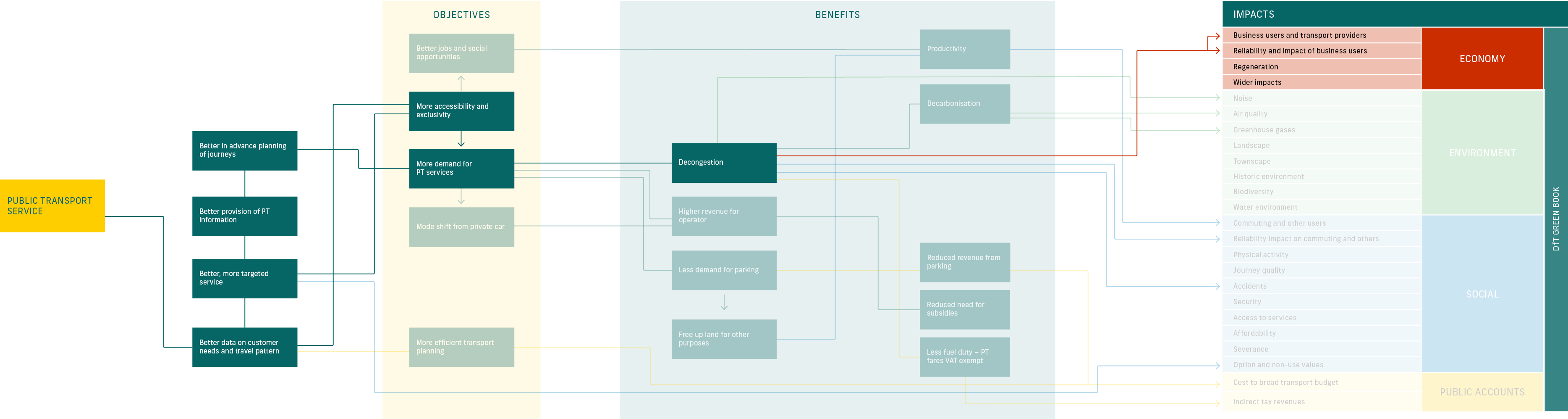
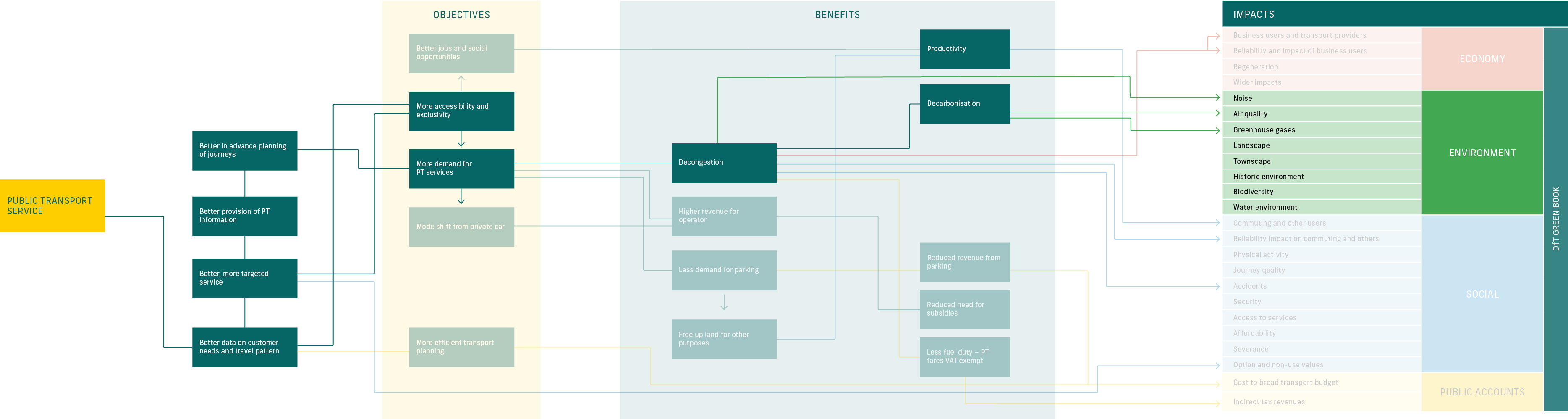
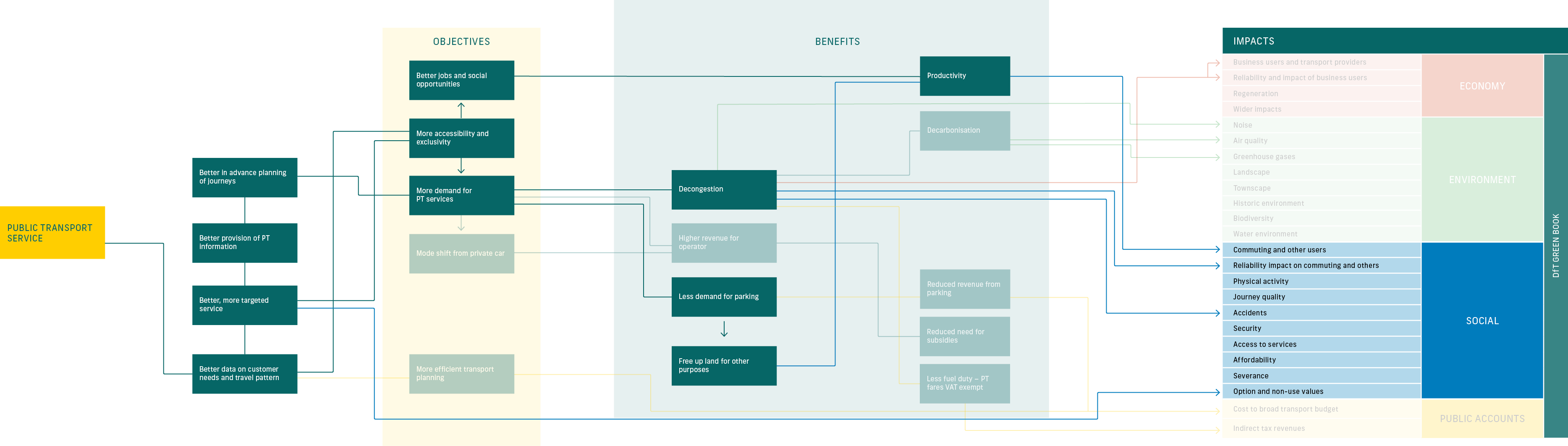
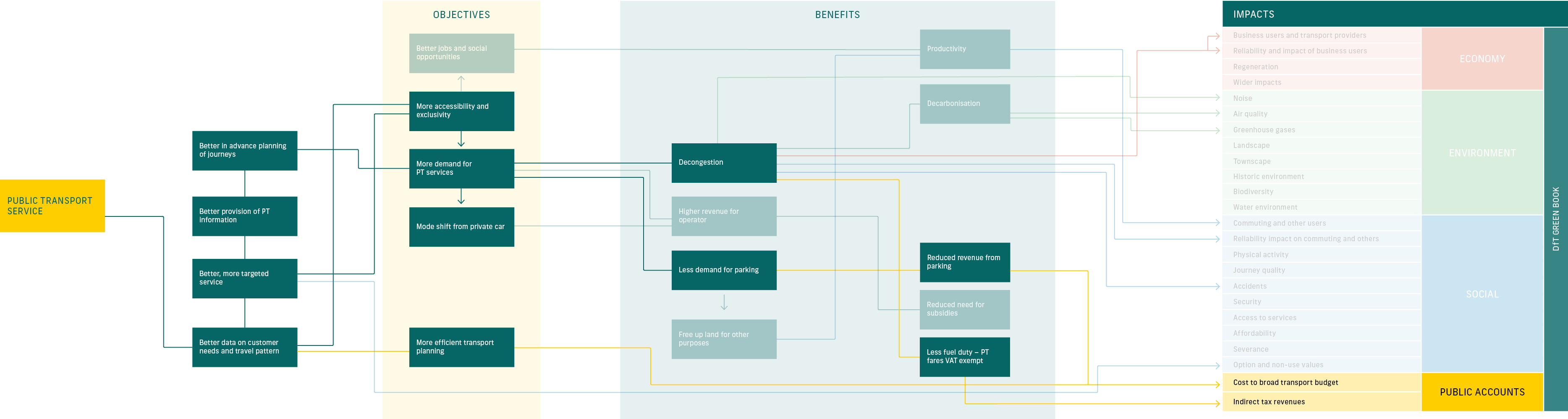
Figure 1 Public Transport Service Impacts Logic Map
View by impact type:

DRAG
Introduction
This section intends to support the development of plans and specifications by providing the following information:
- Actors: who need to be considered in the development of the system.
- Architecture and Data flows: showing how administrators and users interact and use the system, to help identify and develop the needs and specifications of the system.
- Standards: that are important and how these are used in the context of this use case.
- Possible future developments: in practices and technology that may provide opportunities in the future.
The use case architecture is an idealised view of the complete service. Supplier solutions may offer different parts of the complete service and, in that situation, standards will need to be defined to support communication between service components and an integration process will be required. Technical guidance can be accessed via RTIG-Inform a public transport community group seeking to establish, support and share best practice in the use of RTI and communications technology in public transport, including BODS.
Actors
The service design is functionally described by the interaction between the service and the actors (any user or system that interacts with the service).
The following actors need to be given consideration in the development of the service design:
- Passenger: Passengers are the end users of the Public Transport Service. They will be interacting with the service to help them identify, plan, pay for and use the public transport service.
- Bus Driver: The bus driver is the public face of the service and interact with the passenger. They follow the bus route and schedules to pick up and drop off passengers.
- Bus Operator: Bus operators are companies that provide and operate registered local bus services. The primary objective of bus operators is to safely operate the scheduled mileage and adhere fully to the level of service shown in the published timetable. Under the Transport Act 1985, local bus services are required to be registered with the traffic commissioner. The Bus Operator must provide the traffic commissioner with ‘particulars’ of the service, including the route and timetable. They are required to provide and maintain the real-time vehicle location data, also known as automatic vehicle location data, and Fares and Ticket data to BODS.
- LTA Public Transport Manager/Administrator: The public transport manager/administrator within the local transport authority looks after the physical public transport infrastructure and the associated database. This includes the signs and timetables at the bus stop. They are also responsible for uploading data to the public transport information service and keeping this information up to date. For example, bus stops and stations data.
- Third Party Data Consumers: The Department for Transport (DfT) is helping operators meet the statutory requirement through the provision of the Bus Open Data Service (BODS). It’s a digital service which provides access for third-party data consumers to a distributed model of bus open data. Regardless of whether the Bus Operator independently publishes data or goes through a third-party appointed agent/local transport authority to publish their data, it’s the Bus Operators who will be liable for non-compliance.
- Transport Commissioner: Once the local bus service is registered, the Bus Operator must run the service in accordance with the registered particulars or face enforcement action by the traffic commissioner. Under an Enhanced Partnership regime, the requirements of the scheme – either area-based requirements, such as a smart ticketing scheme, or route-based requirements such as a maximum frequency of service on an individual bus route – are included as requirements of registration.
The journey of the passenger through their interaction with the system has been taken as key to the description of this Use Case. Therefore, the Use Case does not describe the processes that a Local Authority will have to go through to develop suitable policy, plans and operational strategies, put in place contracts and the other aspects that will have to be implemented to deliver the overall service.
Architecture and Data Flows
For the purpose of the information and diagram presented in this section, a passenger journey is defined as one ride on a single vehicle – not a bus trip from A to B as this may include more than one bus ride or other modes of travel.
The data flows are illustrated in Figure 2 – Idealised Bus Journey from Bus User and Bus Driver’s perspectives and Figure 4 – Idealised Public Transport Service Architecture from Bus Manager and Bus Operator’s perspectives.
The data requirements and data flows are tabulated in Figure 3 – Idealised User Journey for Bus User and Figure 5 – Idealised Bus Manager/Administrator Activities.
Figure 2 – Idealised Bus Journey from Bus User and Bus Driver’s perspectives
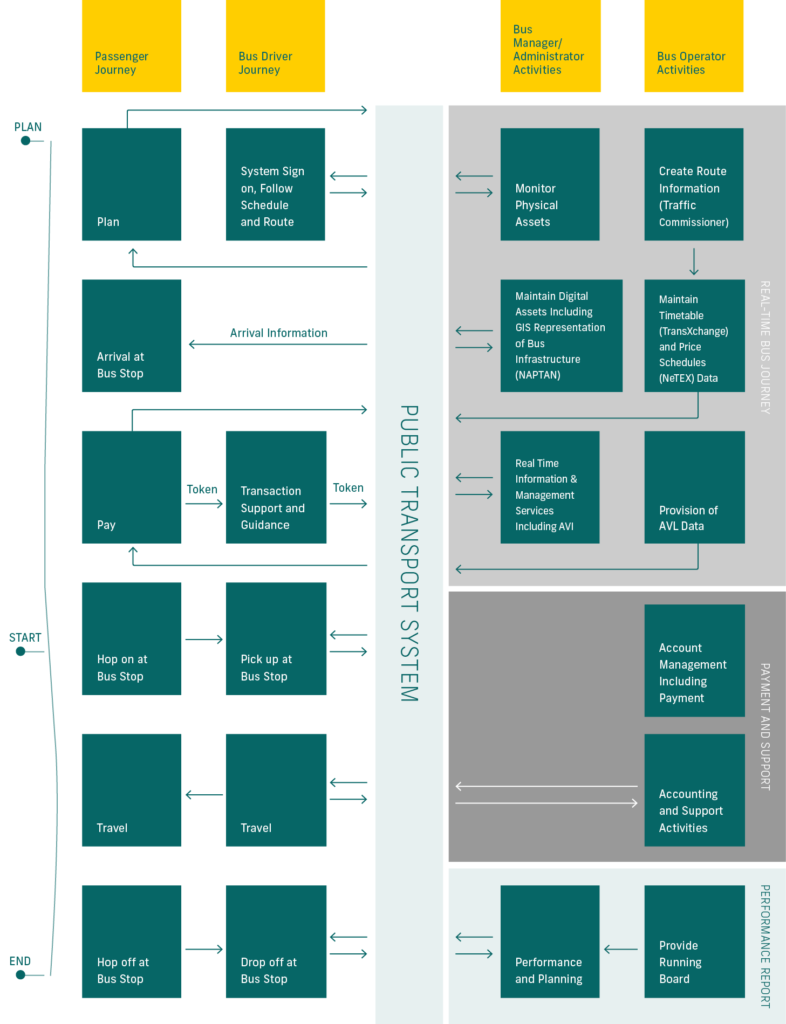
Figure 3 – Idealised User Journey for Bus User


Start
Plan
Arrival at bus stop
"Pay" (token exchange)
"Hop-on"
Travel
“Hop-off”

What the user needs
- As a bus user, I need to know the best travel option for my journey based on preferences such as the route, journey time, cost, accessibility, and weather, so that I can make an informed decision of the type of travel I should make.
- As a bus user, I need to know where the bus stop is including the bus schedule and route information, so that I know I have arrived at the correct bus stop to start my journey.
- As a bus user, I need to know where and how to “pay” for my travel, so that I can make the trip and arrive at my destination on time.
**this step can occur at the same time as hop-on, travel, and hop-off**
- As a bus user, I need to know if my bus will be available and arrive at the bus stop on time, so that I can start the journey and arrive at my end location.
- As a bus user, I need to know if the bus arriving at my stop will meet my needs, including accessibility e.g., a free wheelchair space.
- As a bus user, I need to know if my bus is on time based its schedule, so that I am confident I will arrive at my destination in a timely manner.
- As a bus user, I need to know if my bus is unexpectedly delayed, so that I can replan my own schedule and communicate my new ETA.
- As a bus user, I need to know if I have arrived at the right location, on-time, safely and have paid for the journey.
What the system needs from the user
- Confirm start and end location
- Confirm arrival at start location
- Confirm bus user’s payment method
- Confirm bus user’s journey and travel package
- Confirm pricing and discount eligibility
- Confirm user’s time of journey
- Confirm payment details
- Confirm bus user’s “hop on” stop location
- Confirm user’s “hop on” time
- Confirm accessibility availability and facilitate accessibility options
- Confirm bus user’s status (on-route or hopped off)
- Location and progress in the network
- Changes to journey midway
- Changes to preferences
- Confirm bus user’s “hop off” stop location
- Confirm bus user’s “hop off” time
- Any feedback on bus service
Data requirements
- Confirm time of journey and travel package (day/ off peak /bundle)
- Confirm accessibility requirements
- Timetable information
- Price of journey
- Estimated arrival time
- Alternative options
- Accessibility availability
- Bus stop location
- Pricing
- Schedule “Timetable” information
- Payment information
- Level of service required
- “real-time” estimation of time of arrival based on vehicle location
- Updates on real-time information of impact on networks e.g., diversion/events
- Accessibility availability
- “real-time” estimation of time of arrival based on vehicle location
- Traffic condition and updates on real time information of impact on networks e.g., diversion/events
- Vehicle location
- Arrival time and actual journey time
- Accessibility availability
- User feedback on vehicle driver, route and other aspects of the journey
DRAG
Figure 5 – Idealised Bus Manager/Administrator Activities


Start
Monitor physical assets
Maintain digital assets
Real Time Information and Management Services
Performance Reporting and Planning
What the bus manager / administrator needs
- Up to date view of the status of the physical assets including bus stop availability
- Ensure physical assets are operational and maintained.
- Ensure digital assets are available and maintained so that they reflect the state of the physical assets. This includes bus stop locations, routes and timetable.
- Ensure up-to-date availability of real time information provided to bus users. This includes bus’s status, location, and facilities provided by bus operators.
- Ability to optimise network to improve bus services
- Ability to efficiently respond to disruption. This includes planning of alternative options and communicate this to bus users.
- Ensure bus operators keeps on time of schedule.
- Understand network performance and identify pinch points for bus journeys. This includes changes in patterns of travel where flattened demand in peak periods could mean that operators can reduce their peak vehicle requirement (PVR), reducing the cost of additional vehicles and staff which were previously only required to serve the short, sharp peaks in commuter travel prior to COVID-19.
What the system needs from the manager
- Define and update information of the physical bus infrastructure to be monitored
- Define thresholds and criteria for raising flags
- Provide contact details of relevant responsible users, the contractors
- Define and update performance indicators
- Define criteria and thresholds for raising flags
- Provide contact details of relevant responsible users (IT)
- Report on changes to physical assets
- Confirm bus location
- Confirm bus prioritisation parameters
- Confirm action in response to changes in status of the network. This includes alternative routes and options
- Define and update performance indicators
- Define criteria and thresholds for raising flags
Data requirements
- Bus stop locations
- Bus stop conditions
- Bus stop location
- Bus stop conditions
- Bus stop availability (real-time)
- Bus stop type and size
- Bus stop information (routes and timetable)
- Real time signal phasing data
- (real-time) Vehicle location data and route status
- Data from planning and routing
- Running board of buses
- Historical performance (bus punctuality and patronage)
- Analysis on complaints and customer satisfaction data
DRAG
Interfaces
Interfaces between systems and services will depend on the specific systems design and the boundaries with other systems (regional, international) and services.
The general principle is that interfaces should be specified to use standardised data flows and protocols wherever standards are available, so following standards will support the integration of public transport services.
Interfaces that are dependent on roles for Local Authorities
Local Transport Authorities may wish to support the bus operators in the conversion of automatic vehicle location data feeds into useful Real-Time Passenger Information (RTPI). However, Authorities do not have a statutory duty to provide RTPI, and, if an Authority chooses not to, it will be up to the market to provide RTPI solutions using the Bus Open Data Service.
An Authority may provide support by offering a back-office system if they, or a neighbouring Authority, already have a suitable system.
Standards
The Bus Services Act 2017 requires operators of local bus services in England to publish data to the Bus Open Data Service (BODS) as the central service for publishing high quality information for all local bus services in England. Use of BODS data will enable passengers to plan their journey with confidence and find the best value tickets. It provides bus timetable, vehicle location and fares data for every local bus service in England. This is now made available as open data, as required by the Public Service Vehicle Open Data England Regulations in July 2020.
There are three types of data that operators must published in certain data formats: timetables, bus location and fares. Local transport authorities are required to maintain NaPTAN stop data and should enable operators to publish data to this service to fulfil the operator requirements.
Further information is available at https://www.bus-data.dft.gov.uk/.
Possible Future Development
Public transport service is likely to benefit from a range of emerging technology. Some of which are already being tested and trialled to make journey planning and payment simpler and more seamless:
- Telematics, devices which connect to electronics on-board the bus and allow for the transmission of vehicle data back to the bus manager enable the bus operator to help automate and enhance manual or disconnected tasks:
- – Traditional GPS has limitations, especially in large cities such as London, where satellite signals can be affected by surrounding buildings – known as multipath and urban canyon effects. Enhanced navigation algorithms are used to generate information on the location of each vehicle using the on-board odometer and gyroscopes.
- – Connected buses provide more reliable bus location data, real-time feedback on performance, and in some cases, condition monitoring for bus maintenance.
- – For electrical buses, battery cost is critical and ensuring it is operational for the whole vehicle service life is a challenge. Telemetry data allows operators to monitor the condition of the battery and receive warnings if the limits are exceeded.
- – The Bus Open Data Service has a reporting and analytics extension that delivers a constant, real-time view of the national bus network at any point in time, thereby providing valuable metrics to track and monitor performance across England.
- Downstream innovation such as third-party website and apps that make use of the raw Bus Open Data Service data to create new commercial products and services that exploit big data to improve traveller experiences. Regulations are being considered which could enable bus services to operate in a similar way to on-demand taxis or private hire vehicles. Allowing passenger to book bus travel on their mobile phone in the same way as private hire vehicles.
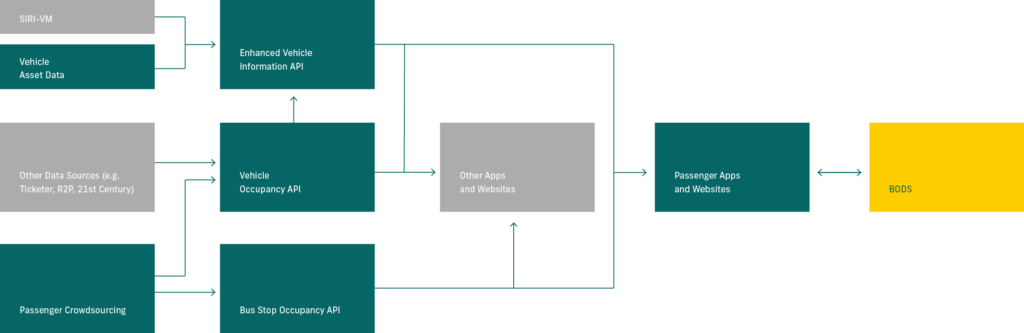
- – Enhanced Vehicle Information system are being rolled out to bus operators to help customers understand more about the bus as it is on its way. These provide customers with new information about the service such as payment options accepted on the bus, availability of WiFi and USB charging points, and vehicle occupancy data – an indication of whether the vehicle is ‘quiet’, ‘moderate’ or ‘busy’ and wheelchair bay availability. These can be infomred by two key sources – crowdsourced data from users, and passenger counting data from ETMs. See Figure 9 below.
- Increasing data analysis and tools can be used to help Authorities to understand key information such as travel pattern data, user demand profiles, congestion and efficiency indicators, and capacity analysis.
- – Data science and software engineers are bringing together complex data from across the UK to create a clear picture for the public. This includes operator data, vehicle location (SIRI-VM) data, ticket use information, disruptions alerts and crowdsourced feedback from end-users on mobile apps and web, as supported by the existing BODS reporting and analytics service.
- – Increasing reliability of data sources – assigning reliability weightings to data sources is key to efficiently blending them to analyse how accurate the information is. This ensures what is presented to the customer is as accurate as possible.
- Improved bus and traffic infrastructure such as smart traffic signal management and countdown signs.
- – Advancements in modern traffic signalvtechnology such as Selective Vehicle Priority (SVP) can be used to extend a green phase or invoke a signal phase change to give priority to buses, in order to improve journey time accuracy.
- Advancements in smart ticketing and payment services can speed up bus use significantly:
- – Multi-operator or multi-ticketing schemes are enabled by moving towards integrated account-based payment with a strong accent on mobile ticketing (m-ticketing) options across all services improving the integration between modes for public transport users.
- – Contactless ticketing technology will can improve the payment and cost monitoring for the bus operators by freeing up drivers from the task of having to manage cash payments. This means that passengers who need to use cash benefit from faster boarding times.
- Future transport zones have been established to create ‘mobility hubs’ that integrate and interconnect with other transport modes to encourage uptake of public transport:
- – There is increasing evidence that simplifying fares encourages bus use by reducing uncertainty and anxiety for passengers. Bus operators and Authorities may wish to consider introducing a simple zonal structure, or a set fare across all journeys. A requirement on all operators to set their fares with reference to the same structure can be implemented through franchising or an enhanced partnership scheme, though not through an advanced quality partnership.