Smart Traffic Signal Control supports optimisation of traffic movements and enhancement of services provided to road users, creating opportunities to operate traffic signals more efficiently, smoothing traffic flows and reducing congestion. In the medium-term, this can provide better guidance to road users via connected services and data.
Latest update: 21 April 2023
Signal Control

Traffic Signals are a vital roadside infrastructure enabling the safe and optimised movements of traffic. The adoption of smart, connected and digitalised smart traffic signal control allows further efficiencies, optimised traffic flows and new vehicle priorities to be realised. Presenting opportunities to encourage more desirable road user behaviour through adoption of connected services that increase the quality, availability and utilisation of traffic datasets.
Smart signal control involves using new data sources, such as connected vehicle data, new technologies and co-operative and/or connected services to advise the optimisation of the flow of traffic and improve the road user experience by:
- Smoothing traffic flows, reducing delays and congestion for all road users.
- Increasing data sharing between Authorities and third party service providers, increasing the quality and availability of information and services.
- Introducing services such as Green Light Speed Advisory (GLOSA) that may influence the way road users interact with traffic signals.
And provides opportunities for Authorities by:
- Improving the quality and availability of traffic datasets to support transport planning and road network operations.
- Improving road network efficiency by the reduced dependency on traffic surveys and physical infrastructure using improved monitoring data and digital operational processes.
The Need for Smart Traffic Control
Traffic Signals are a vital part of the road network infrastructure that regulates traffic to provide optimal and safe priorities between opposing flows of vehicles, pedestrians, cyclists and public transport. They provide a network of traffic sensors that generate a rich dataset for monitoring and planning purposes and an infrastructure that may be used to implement strategic network controls in response to incidents and events.
The management of traffic signals, has a significant influence on the performance of road networks and road user behaviour in addition to the quality and availability of traffic data to support end-user services and wider Authority processes.
The adoption of smart traffic control provides opportunities to deliver efficiencies and improved services through:
- Improving efficiencies of services and reduced expenditure through less reliance on physical infrastructure, reduced maintenance requirements, and adoption of more efficient digitalised processes.
- Increasing optimisation of traffic flows through more intelligent traffic controls based on better input data.
- The positive influence of road-user behaviour through co-operative connectivity, intelligent traffic controls and information services.
Current trends
SCOOT and MOVA adaptive control systems continue to be widely used by Authorities, whilst the technology and products for traffic signal control are undergoing continual improvements. For example:
- The latest version of SCOOT version 7.0 released in 2020, includes support for co-operative green light speed advisory data and optimisation of pedestrian green man phases based on numbers of pedestrians.
- The latest version of MOVA, M8, provides a significant upgrade having special conditioning, new communications methods that includes a junction mimic screen, additional bus priority facilities and a web user interface along with further developments to support GLOSA at MOVA junctions
- Alternative adaptive traffic control products are becoming available e.g. provided by Yunex.
- Traditional traffic sensor technologies of inductive loops, and infrared / microwave detectors continue to be widely used. An increasing range of products based on alternative technologies are being adopted including those based on:
- – Floating vehicle data (e.g. York eboracum project)
- – – Magnetometers
- – Radar / Lidar
- – Computer vision/Video Analytics (e.g. Vivacity)
- – Cellular/Bluetooth scanners
Co-operative intelligent traffic systems (C-ITS) have a significant body of standards and technical specifications. However, the C-ITS use-case relevant for traffic signal controls is not yet mature enough for products to be available on the open market, but numerous trials have taken place in the UK and abroad including:
- Trials of GLOSA services, such as in York, Birmingham, Manchester, National Highways and Coventry (UK CITE).
- The PATH project for traffic signal monitoring using floating vehicle data across 11 UK Authorities.
- Surface Intelligent Transport System (SITS) TfL.
- The Eboracum project for signal plan selection using FVD.
- The A2M2 connected corridor and InterCor operations.
- The FLOURISH C-ITS trials in Bristol.
Services and products for public transport and active mobility users are providing datasets that are useful for planning, performance and safety analysis including:
- The Bus Open Data Service (BODS) provides timetable, vehicle location and fares data for local bus services in England. Since 7 January 2021 bus operators have been obliged to publish basic ticket/fares and location data. BODS may therefore be a useful data feed for implementing real-time bus priority controls.
- See.Sense provides bicycle lights and tracker products with GNSS/sensor telemetry capabilities, and has developed analysis techniques that provide data insights that include dwell time and congestion for cyclists which may be used to plan and configure more effective signal controls for cyclists.
- The Strava fitness app platform provides a dataset called Metro to relevant bodies with the intention of helping to make human-powered travel more efficient, safer, and more accessible.
People’s travel behaviour is becoming increasingly influenced by connected data services including:
- Vehicle manufacturers provide data connectivity and digital services including in-vehicle connected navigation and parking.
- Use of third party route planning and navigation services, which may use crowdsourced and/or Floating Vehicle Data (FVD) to provide enhanced services such as highlighting congestion delays or traffic incident locations.
This shift in influence generates a need to adopt new approaches and practices to continue to influence user behaviour and opportunities to increase the impact the traffic services have.
High-level objectives
The adoption of smart signals supports the achievement of some or all of the following:
- Publishing traffic data to a common database or data hub (or both)
- – Collating key traffic data collected from traffic signal infrastructure into a common database or hub provides a dataset to support tactical and strategic transport operations.
- Adopting connected / intelligent traffic data sensors
- – Adoption of new traffic sensor technologies including magnetometer, radar, video analytics and connected data provides opportunities to reduce ongoing maintenance costs, migrate from legacy systems and improve the availability and quality of traffic data, enabling a more intelligent use of traffic controls.
- Subscription to third party provider vehicle traffic and incident data.
- – Alternative to traffic sensor infrastructure, potentially reducing maintenance costs.
- – Integration with incident data such as WAZE which can automatically alert and provide the location of network incidents.
- Publishing traffic and incident data for use by third party services
- – Enabling new services for road users.
- Implementation of network and signal optimisation facilities that subscribe to common database or data hub inputs such as FUSION being developed by TfL and Yunex. Such appraoches can optimise traffic at a network level, and in addition to using existing signal optimisation tools, are used to produce more widespread impacts:
- – Network management and signal optimisations, or interventions, to account for network incidents or events, such as air quality alerts, and maintain performance.
- – Enabling operational staff to make better-informed decisions based on a wide range of timely, accurate and relevant information.
- Introduction of infrastructure to vehicle traffic services
- – Services such as Green Light Speed Advisory smooth traffic flow and improve the efficiency of travel. Particularly beneficial for buses and freight vehicles to avoid unnecessary stops of heavy vehicles and maintain journey time reliability for passengers and hauliers.
- Making use of connected datasets for optimisation of public transport and vulnerable road user facilities and/or integrate these into the signal method of control.
- – Connected data including Bus Open Data (BODS) and co-operative messaging provides real-time data. For example, whether a bus is ahead or behind timetable, allowing optimisation of traffic signal priority to provide more reliable services.
- – The latest versions of traffic control systems such as SCOOT or MOVA allow bus priority to be integrated into their configuration, allowing better performance and balance of priorities for all road users and greater transparency on implemented optimisation policies.
Supported policies and duties
Smart traffic signal control supports the following policies:
- The Government’s National Infrastructure Strategy and the DfT’s Transport decarbonisation plan discuss decarbonisation based on places. Publishing traffic data and implementing facilities that help to improve traffic control, travel planning and guidance further support the use of sustainable travel modes, reduce congestion and improve air quality. The adoption of digital traffic databases and connected data improves access to quality data to support strategic planning operations, making more effective use of resources and enhancing transport planning projects including those to promote active and sustainable travel.
- The UK Government’s National Data Strategy sets out an action plan which includes the mission of transforming the Government’s use of data to drive efficiency and improve public services. The UK Innovation Strategy sets out the Government’s ambition for the UK to be a global hub for innovation with the world’s best innovation ecosystem. This includes:
- – Continual adaptation of new products and technologies.
- – Capitalising on data – creating an environment where data is usable, accessible and available.
- – Designing successful innovation – by putting the needs, wishes and behaviours of people at the heart of the innovation process.
- Implementing and demonstrating the network management duties placed on local traffic Authorities by the Traffic Management Act 2004 including:
- – Securing the expeditious movement of traffic on their road network, and facilitating the same for other road networks.
- – Promoting the more efficient use of their road network.
- – Avoiding/eliminating/reducing congestion/disruption to the movement of traffic.
- Adoption of technology and digitalised processes may support the Authority’s policies to be achieved or further developed. Placing emphasis on delivering improvements to traffic performance, promoting active/sustainable travel, or delivering improved customer services, which is strongly supported by providing well-connected traffic data management facilities and enhanced traffic technology infrastructure. Providing increased ease of access and providing enhanced information relating to accessibility and surrounding facilities may also help to improve monitoring and satisfaction of duties placed on the Authority by the Equality Act 2010 and/or Disability Discrimination Act 2005.
Qualitative Benefits
Smart traffic signal control can provide the following qualitative benefits:
- Optimised signal control that influences desirable driver behaviour, increases the reliability of journey times and effectiveness of public transport.
- – Achieved through improved availability and fidelity of data for traffic control, integration of signal optimisation with public transport user facilities and implementation of the vehicle to infrastructure services.
- – Provides opportunities to improve effectiveness of signal control and prioritisation, and to influence road user behaviour.
- More efficient operations and reduced maintenance operations:
- – Improved digitisation and connectivity of equipment lead to improved efficiency.
- – Adoption of connected data as an alternative to existing, or legacy, infrastructure sensors for new more efficient or less vulnerable technologies to reduce maintenance operations, costs and migration from ageing, legacy, systems.
- Improved customer access to services and information
- Improved quality and availability of traffic datasets.
- – Improved traffic sensors, subscription to connected data and publication of traffic data to a common database.
- – Supporting the Authority’s traffic planning, and tactical operations activities.
- Improved traffic data for active mobility and vulnerable road users.
- – Making asset data digitally available to users, either directly or via third parties; improves services for users.
- – Helps users to make more informed choices, to encourage more sustainable, or active, travel choices.
- – Improves users’ access to services and information; provides an overall improvement in customer experience.
- – Publishing datasets for use by third party services improves the range and quality of services provided.
Quantitative Benefits
Smart traffic signal control can support the following quantitative benefits:
- Reduction in physical infrastructure
- – Reduces maintenance requirements and improves the streetscape
- Reduced road casualties
- – Improved data supporting planning and design processes
- – Improved road user behaviour
- Increased update of active mobility travel
- – Improved data supporting planning and design processes
- – Improved connected data services
- Increased patronage of bus services
- – Achieved through increased service reliability and effectiveness
- Smoothed traffic flow
- – Achieved through increased uptake in public transport, active mobility, optimised signal control and influencing driver behaviour
- Reduced expenditure
- – Reduced need for manual traffic surveys
- – Reduced physical infrastructure and maintenance
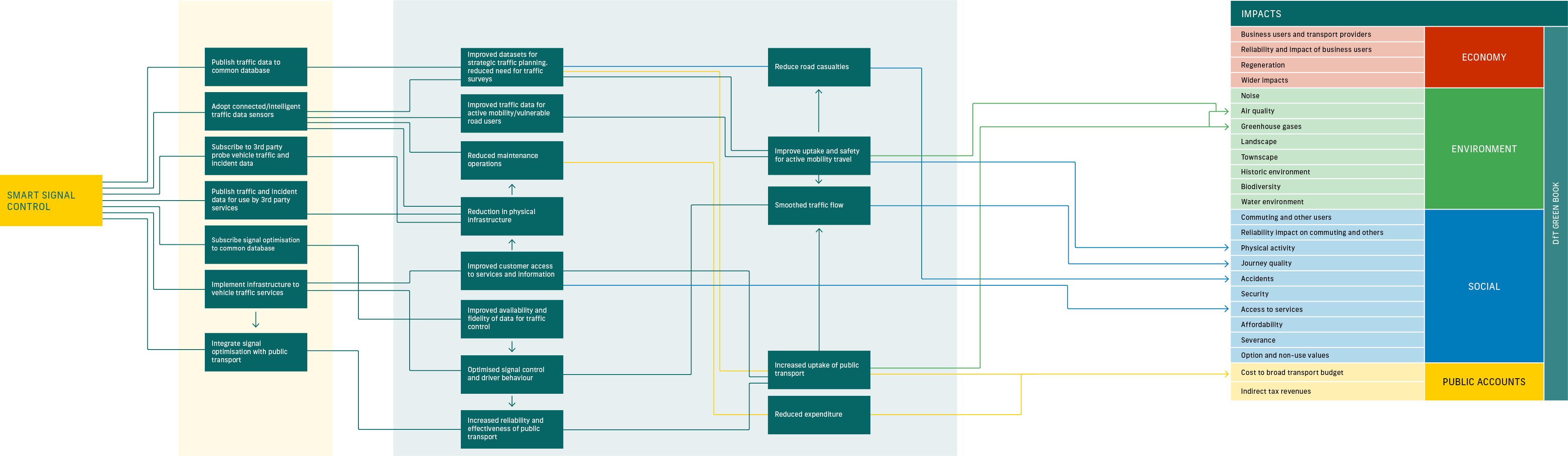
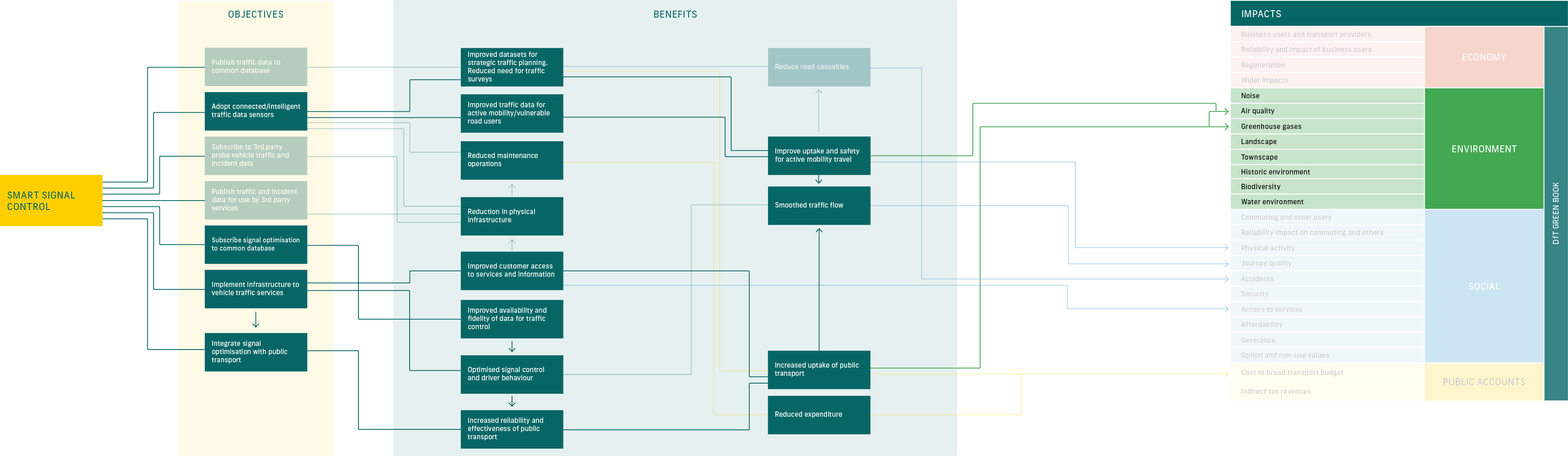
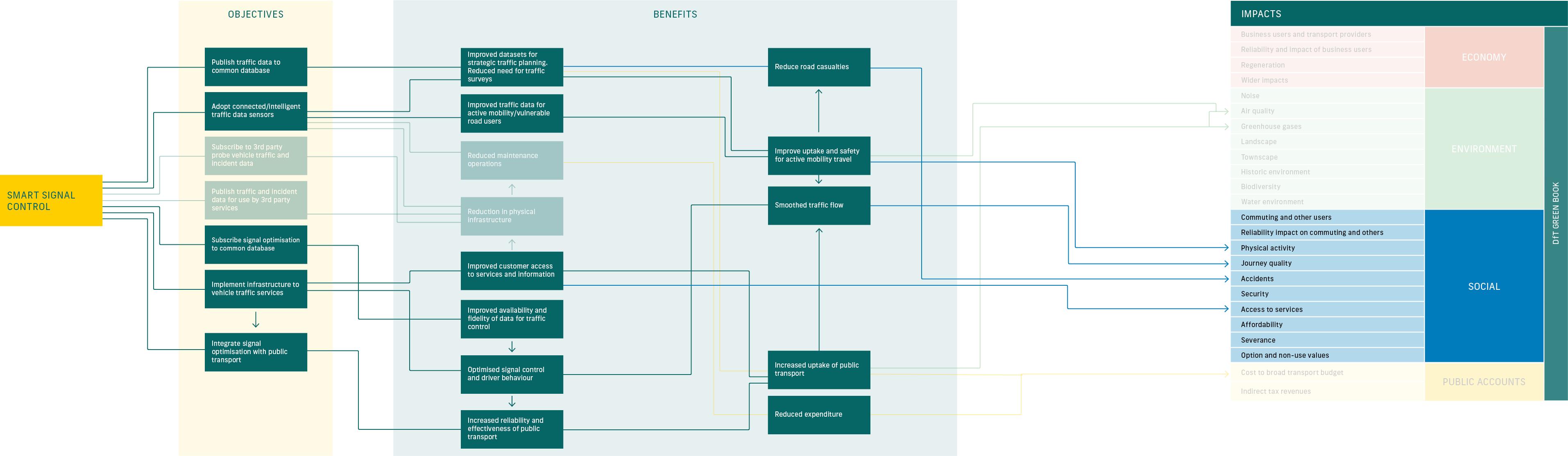
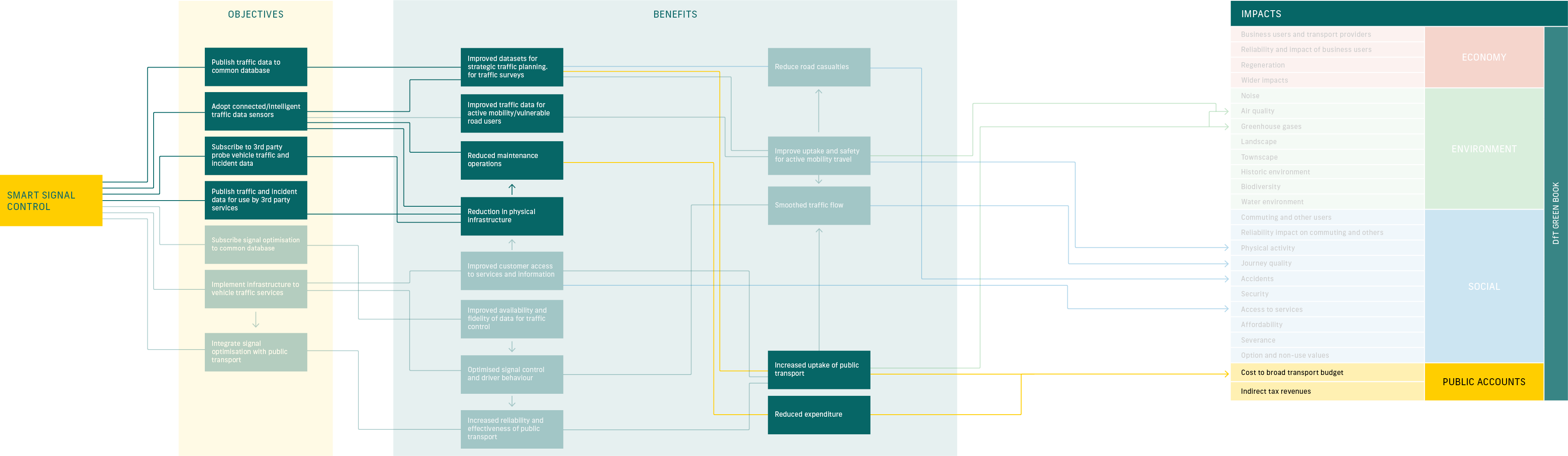
The potential impacts of smart traffic control are illustrated by the logic map shown in Figure 1 below.
View by impact type:
DRAG
Introduction
This section supports the development of plans and specifications by providing the following information:
- Actors: who need to be considered in the development of the system.
- Architecture and Data flows: showing how administrators and users interact and use the system, to help identify and develop the needs and specifications of the system.
- Standards: that are important and how these are used in the context of this use case.
- Possible future developments: in practices and technology that may provide opportunities in the future.
Actors
The service design is functionally described by the interaction between the service and the actors (any user or system that interacts with the service).
The following actors need to be considered in the development of the service design:
- Road users: who interact with traffic signals either directly through the use of on-road facilities, or indirectly through the use of services using the data provided by traffic signal infrastructure.
- Authority: who is legally responsible for providing and operating the traffic signal control system.
- Third-Party providers: third parties may support Authorities in implementing and operating traffic signals through the supply of products and/or services. They may also deliver digital services to road users supported by data derived from the signal facilities.
Architecture and Data Flows
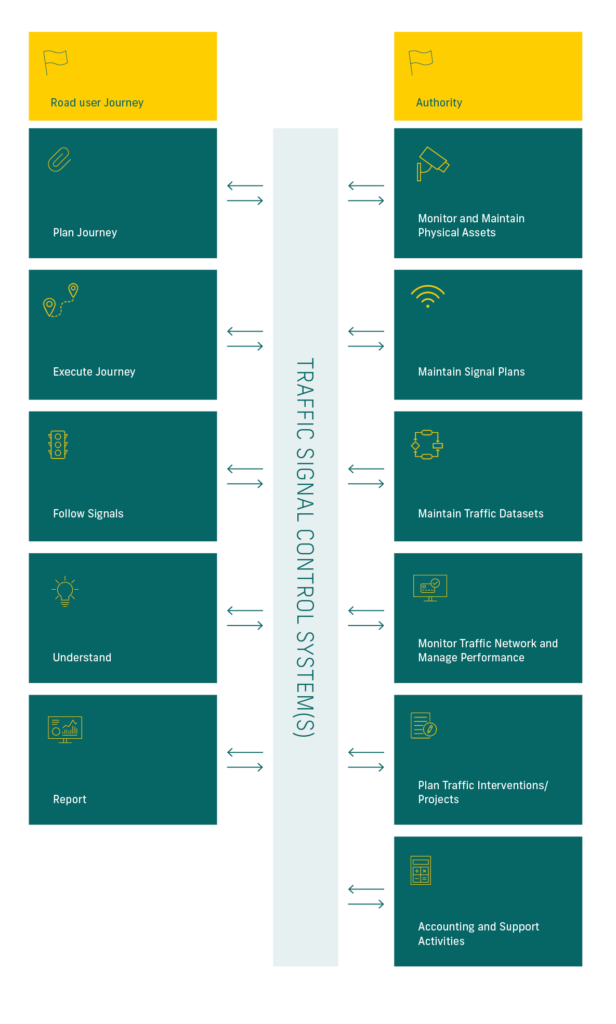
For the purpose of the information and diagram presented in this section, a road user journey is defined as a single journey undertaken by one vehicle. However, similar activities apply to navigation service providers and logistics managers.
The data flows are illustrated in Figure 2 – Idealised road user journey for traffic signal control and Figure 4 – Idealised Traffic Signal Control Manager’s processes.
The data requirements and data flows are tabulated in Figure 3 – Data Requirements for idealised user journey for signal controls and Figure 5 – Data Requirements for Idealised Traffic Signal Manager / Administrator Activities.
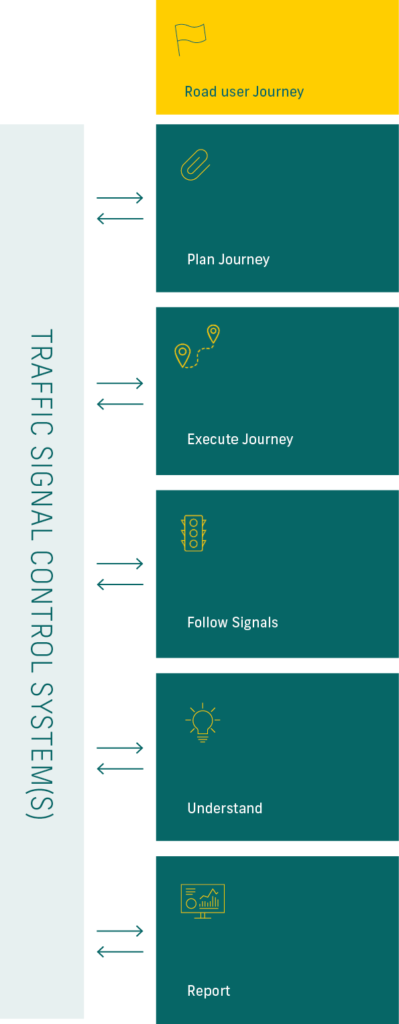
Figure 3 – Data Requirements for idealised user journey for signal controls


Start
Plan Journey
Execute Journey
Signal Directions
Understand
Report

What the user needs
As a user, I need to know the best options for my journey based on preferences such as the travel mode, and traffic attributes such as time of day, expected traffic, planned events or road works so that I can make an informed decision for the option I choose.
As a user, I need to be updated on real-time factors affecting my journey such as traffic incidents or congestion. So that I can start my journey and decide whether changes that require re-routing in order to arrive in a timely manner.
As a user, I need to be directed by traffic signals that operate safely and reliably to optimise my journey. I need to clearly understand the directions of signal controls for my journey.
As a user, I need to know what facilities and services are available to me.
As a user, I need to be able to report issues, know the processes to do so, and be notified on decisions and updated on response to reported issues.
What the system needs from the user
- Confirm start location and
- Confirm (likely) journey time
- Confirm desired travel mode
- Confirm user specific preferences and needs.
- User’s location and planned route.
- Travel mode
Compliance with signal directions or C-ITS services, such as GLOSA
- Language / Accessibility requirements
- Location or Topic
- User location and or location of interest
- Type of issue / asset involved / site reference number.
- Photographic evidence
- Description of issue
- Whether the issue is safety critical
- Date / time
- Contact details and preferences
Data requirements
- Location for journey start
- Historic journey times
- Permitted routes
- Planned events/roadworks
- Real-time traffic data (e.g., speeds)
- Traffic events/incidents/route restrictions
- Current user location and route
- Estimated travel time
- Language / Accessibility information
- User preferences (profile)
- Location or topic
- Levels of service descriptions
- Service usage descriptions Duration of stay
- Location / area of interest
- Date / time
- Contact details
- Contact preferences
- Fault logs
DRAG
Figure 5 – Data Requirements for Idealised Traffic Manager / Administrator Activities


Start
Monitor and maintain physical assets
Maintain signal plans
Manage traffic datasets
Monitor traffic network & manage performance
Plan traffic interventions / projects
Accounting, reporting & support activities
What the authority manager / administrator needs
- Up to date availability and status of signal asset operational performance.
- Work currently in progress by contractors
- To ensure signal assets are operational and maintained (based routine and reactive maintenance requirements)
- Current signal plans and performance reports
- Reported customer issues
- Traffic policies/priorities
- Traffic models / forecasts of plan performance
- Tooling to develop and deploy revised signals plans
- To know how long to retain different types of data
- What data is available to what groups of users.
- A database to manage data and standards for data formats
- Up to date performance data of traffic network
- Incident reports
- Planned events
- Reports on age and reliability/availability of assets.
- Trends of traffic performance and flows
- Known site issues, Collision/Safety data
- Have the ability to review, validate and address customers’ complaints
- Reports on asset inventory
- Reports on service provider activities
- Reports on incidents
What the system needs from the manager
- Define and update signal asset data
- Define thresholds and criteria for intervention & response.
- Define and update performance indicators
- Define criteria and thresholds for raising flags
- Provide contact details of relevant responsible users
- Data retention configuration
- Data formats
- User account control
- Verification of reported issues
- Control/response strategies
- Report formats
• Define decisions about disputes and complaints
Data requirements
- Reported customer faults
- Signal faults
- Signal availability
- Asset inventory
- Service providers for each asset
- Traffic flow data
- Traffic performance data
- Signal / network configuration data
- Data policies
- Data formats
- Data collection asset information
- Response policies/strategies
- Operational procecures
- Historic performance data
- Signal asset inventory
- Signal availability data
- Signal maintenance records
- Traffic flow data
- Traffic performance data
- Collision data
- Issue reports
- Payment system performance
- Information from enforcement management
- User transaction data
- User contact details
DRAG
Interfaces
Interfaces between systems and services depend on the specific design and the boundaries with other systems and services. The general principle is that interfaces should be specified to use standardised data flows wherever standards are available such as UTMC, and specifications such as TOPAS.
Standards and Specifications
It is important to align with and/or support the development of National Standards:
- To ensure the digitalised services consumed by customers is Authority agnostic and users do not have to have different apps/services for different towns and cities.
- To ensure the services can interface with recognised customer-facing accounts e.g. Google, Apple, OEM -based services.
DATEX II (CEN/TS 16157) is a multi-part set of international data content and framework standards for road transport and traffic telematics.
UTMC provides traffic managers with open technical specifications that support an innovative, competitive, marketplace that assists effective system interworking. The Urban Traffic Management Control Specification and Standards Group produces and maintains UK intelligent transport systems technical specifications which is the core of the UTMC initiative. This includes:
- The TS003 framework specification: defining the general architecture for UTMC systems which is based on current mainstream ICT practice where practicable and aims to avoid bespoke solutions which are difficult to support.
- TS004 objects register: defies the formats and structures of data objects used in UTMC systems including traffic control system functions, the road network descriptors and information structures such as “predictions” or “faults”.
- UTMC provides guidance and good practice on UTMC linked specifications. This includes traffic data as DATEX II profiles, which can be considered for implementation by traffic managers in their UTMC systems’.
Since April 2016 TOPAS (Traffic Open Products And Specifications) replaced the previously statutory Type Approval and TOPAS Product Registration became live for new product registrations for traffic control equipment, with the aim of promoting convergence of specifications to reduce the risk of operational problems. TOPAS’ product registration enables customers to verify compliance of solutions they purchase and Authorities may specify TOPAS compliance within their procurement documents.
Under the European ‘Co-operative Intelligent Transport Systems’ (C-ITS) programme a range of standards have been produced and continue to be developed. ITS specifications are developed to address specific service domains such as public transport, road safety, freight and logistics, emergency services and systems such as electronic fee collection.
C-ITS services are based on the concept of data exchange between vehicles of any category, the roadside infrastructure, control and service centres and other road users such as pedestrians and cyclists with guidelines on their use published by ISO and CEN.
Possible Future Development
Areas currently near to market and in development include:
- Real-time model signal strategies, potentially using AI approaches. Several vendors offer strategy selection systems and AI UTC systems that will compete with traditional systems, and many more are in the pilot stage.
- New sensors at the roadside to replace loops, especially using image processing to identify and classify pedestrian and cyclists as well as monitoring traffic movements.
- Use of floating vehicle data to replace or augment data collected from sensors.
- Linking UTC plans to wider services such as in-vehicle information.
- Potential new Public Transport priority systems based on BODS.