Smarter asset management, supports Authorities to build on their existing capabilities, make use of new technologies, access new and connected asset data, improve systems and data integration and co-ordinate applications to optimise maintenance management. Supporting an essential infrastructure for communities, commerce and wider society.
Latest update: 21 April 2023
Asset Management

Road infrastructure and equipment is the most valuable asset owned by Authorities. In this use case focuses, opportunities to enhance the management of road assets through the adoption of new sources of data and greater levels of digitalisation and insight are considered.
The practice of managing road network infrastructure assets has established guides and codes, in particular the Highways guidance and codes of practice published by UKRLG and the CIPFA Code for Transport Infrastructure Assets. The Manual for Smart Streets, and this use case, do not intend to replace these existing defined practices, rather to supplement them with advice on implementing ‘smart’ asset management, accessing new sources of data, potentially with greater network coverage and with more frequent updates. Additionally, making the best use of shared data brings opportunities to unlock capabilities and improve efficiency through integration.
Smart asset management enables access to new sources of data, largely sourced from in-vehicle sensors or smart devices carried by users or within vehicles, and innovative approaches to processing it to provide opportunities to:
- Capture and untilise in-vehicle sensor data through devices fitted to Authority vehicles or the general vehicle fleet, enabling ongoing capture and processing potentially from multiple sources, anywhere on the network. Other sources of data can complement this: existing survey, inspection and defect data; crowdsourced data; etc.
- Offer more cost-effective, wider spread, coverage of asset data collected,
- Support more focused targeting of traditional surveys.
- Break down operational siloes, strengthen the culture of sharing and reuse of data.
- Provide improved ongoing insight on the state and performance of network assets, through:
- – wider coverage, more cost-effective, improved data,
- – improved data sharing, and
- – utilising tools to ease access to data and support for asset management tasks.
Road infrastructure and equipment are the most valuable asset owned by Authorities throughout the UK. These approaches have the potential to deliver substantial, positive changes especially due to the critical interface that the infrastructure and equipment provides between the Authority’s customers and a variety of wider services and provisions.
The need for Smart Asset Management
The economic contribution of highway maintenance is recognised in the Audit Commission report Going the Distance. The report highlights that: “Councils must use their road maintenance to support the economic competitiveness of their area. Roads play a critical role in public service delivery and economic growth – both through the increased mobility of citizens, goods and services, and through building and maintaining infrastructure”. This case is further strengthened by the Highways Maintenance Efficiency Programme report Potholes Review whose key messages and recommendations include that:
- Prevention is better than cure, intervening at the right time will reduce the number of potholes forming and prevent bigger problems later. This includes recommending:
- – Long term planning to determine the balance between structural, preventative and reactive maintenance activities.
- – Works coordination: All parties undertaking works on the highway should share and co-ordinate short and long term programmes of work for up to four years in advance. Minimising long term damage from the installation, renewal, maintenance and repair of utility and highway apparatus through alternative and innovative ways of working.
- Right first time. Includes recommending that Authorities should consider using proven technology and systems for the effective identification and management of potholes.
- To provide clarity for the public, Authorities need to communicate to the public what is being done, how it is being done and manage expectiations about what is possible.
Effective asset management is a relevant concern for Authorities because:
- Road infrastructure and equipment are highly valuable assets. Therefore, a relatively small increment in asset management performance through smart practices may cause significant direct savings. Compared to, for example, a change in signal timings that generates economic savings that don’t accrue to the Authority.
- Road asset management affects the condition and availability of infrastructure and equipment which has a strong impact on the experience of road users both directly and indirectly by affecting the performance of other services such as traffic management and the availability and utility of the network.
- The undertaking of asset management relates to legal responsibilities placed on Authorities by legislation, the Authority’s level of exposure to civil claims and hence expenditures.
- The way asset records are managed can significantly impact the performance of many other Authority services and functions. Effective digitalisation of asset management provides opportunities to improve the utilisation of existing assets and perform services more effectively and efficiently, again with financial savings.
What does smarter asset management bring?
- Opportunities to use digitalisation and apply technology and improved data sharing in the execution of asset management. Utilising new, low-cost sources of data (such as in-vehicle and smartphone sensor data) to provide network-wide coverage of asset features and conditions, which in turn:
- – Support the opportunity for earlier insight into asset deterioration, and issue identification.
- – Improve the potential for earlier reactive maintenance, with a shift from fixed time-interval to on-occurrence reporting and intervention.
- – Enable development of a more comprehensive and timely view of the network-wide state of assets.
- – Reduce duplication of data whilst improving the whole asset view of the transport network.
- – Promote planning and executing maintenance activities more effectively.
- – Providing more efficient, effective and transparent asset management related customer services.
Current trends
Asset management system products are offering increasing digitalised and connected capabilities. This may include:
- Migration to digital asset management systems and spatially-aware based asset records through the use of Geographic Information Systems (GIS).
- Emerging software products and services, such as a digital assistant, support improved efficiency of routine tasks, enquiry resolution, and analysis and reporting. Implementation examples have claimed a five percent improvement in the efficiency of the delivery of asset management services.
- Use of connected processes for asset condition reporting, defect investigations, and inspections.
- Increased integration of asset management, customer management, works orders, and accounting systems into a single connected platform, and linkage to customer-facing information services (which may be third party services). Requiring an Authority-wide data centred approach, including:
- – collating disparate data onto shared platforms,
- – ensuring data accessibility through monitoring of use restrictions in supplier contracts
- – a culture of cross-departmental cooperation within the Authority
These increasing capabilities offer significant opportunities, however, they also introduce additional challenges for authorities to navigate including:
- Ensuring that increasingly complex products fulfil needs and deliver expectations.
- Designing implementation of the new solutions with legacy systems and processes.
In addition to the adoption of new and emerging technologies, Authorities are increasingly making use of services providing access to in-vehicle sensor data (Lidar, smartphone camera, etc.) which can provide low cost, network-wide coverage, and high-frequency insight on network asset conditions and status.
Third-party services and product providers are increasingly able to provide datasets that are useful for monitoring asset conditions. For example, See.Sense provides bicycle lights and tracker products with GNSS/sensor telemetry capabilities, and have developed analysis techniques to provide data insights for highways. Including a road surface index that has demonstrated a strong correlation to visual inspection surveys and is able to provide an automated and regularly updated mapping of surface quality. Such datasets provide insights on the level of comfort the road surface delivers to cyclists which could facilitate an improved risk and service level based asset management to be delivered for more vulnerable road users.
High-level objectives
The adoption of smart asset management supports the achievement of some or all of the following objectives:
- Greater optimisation of asset maintenance, doing more for less, intervening at the right time.
- Supporting enhanced user experience, using improved insight to support better maintenance planning, advising on necessary disruption in a more predictable (better communicated) way.
Achieving improved outcomes:
- More digitalised asset management:
- – Improving asset management and wider authority processes through the use of digital information and technologies.
- More efficient and higher quality condition surveys:
- – Using technology to improve the cost-effectiveness, consistency, fidelity and frequency of condition surveys.
- – Using novel data sets to enable the improved targeting of condition surveys.
- Use of vehicle data in pavement and structure management:
- – Integrating current and forecast vehicle data to inform more effective long-term decisions on maintaining and protecting road infrastructure.
- More effective reporting of customer maintenance issues:
- – Providing a connected and digital interface for reporting issues improves the customer’s experience, improves the quality of the reported information, and allows customer issues to be managed more efficiently.
- More efficient defect inspections
- – Using connected digital processes increases the efficiency of defect inspections.
Supported policies and duties
Smart asset management supports the following policies and duties:
- The UK Government National Data Strategy sets out an action plan which includes the mission of transforming government’s use of data to drive efficiency and improve public services. The UK Government Technology Innovation Strategy sets out the Government’s ambition to make the UK the world’s most innovative economy, and place us at the forefront of the technologies of the future. This includes making changes towards useful, accessible data to create service improvements; and adopting technology infrastructure that can adapt and change. Smart asset management is an example of implementing these plans.
- Adoption of technology and digitalised processes supports the authority’s policies to be achieved or further developed. This may place emphasis on delivering quality customer services, which is strongly supported by providing well-connected facilities to communicate with customers on road maintenance issues. Improvements to services or asset conditions may also help to improve monitoring and satisfaction of duties placed on the authority by the Equality Act 2010 and/or Disability Discrimination Act 2005.
- Support the cost-effective management of the Authority’s duty to maintain the highway placed on them by section 41 of the Highways Act 1980. Digitalised processes can effectively determine reasonable risk-based maintenance responses. This helps provide a justified robust defence to potential compensation claims, as prescribed in section 58 of the Highways Act 1980, which may reduce the authorities’ exposure to claims related costs.
- The CIPFA Code of Practice on the Highways Network Assets, advises how to implement asset management accounting to meet Whole of Government Accounts requirements according to the Government Resources and Accounts Act 2000. Smart asset management helps to meet these requirements efficiently with streamlined digitalised processes.
- The ‘Highway Infrastructure Asset Management Guidance Document’ published by the UK Roads liaison group as part of the Highways Maintenance Efficiency Programme provides a framework and guidelines for implementation by Authorities which links to UKRLG codes of practice. Smart traffic management helps to enable the implementation of this guidance in particular:
- – Digitalisation helps to meet recommendations for asset data management. Regularly reviewing the quality, currency, appropriateness and completeness of all data supports asset management. This includes maintaining an asset register to store, manage and reports all relevant asset data.
- – Asset management systems: Developing, procuring and integrating the functionality of an asset management system that enables asset management through appropriate management, reporting and communication of information and data.
- The Audit Commission ‘Going the Distance’ and the HMEP ‘The Potholes Review, Prevention and a Better Cure’ reports make recommendations for Asset Management. This includes recommending optimal asset management through collaborative/informed long term planning, procurement, investment and operations decisions. Smart asset management supports this by enabling accurate and long-term planning and procurement decisions to be reached, supported by data driven analysis.
- The New Roads and Street Works Act 1991 places network co-ordinator duties on authorities, and although the management of statutory undertaker works is not directly considered in the scope of this document, the co-ordination of road works between all organisations and communication of maintenance plans are recognised as opportunities for smart asset management.
Qualitative Benefits
Smart asset management can provide some or more of the following benefits:
- Better utilisation of existing assets: The use of digital GIS and asset database information in processes improves the visibility and knowledge of existing assets and provides the potential to utilise them better. In addition, new sources of asset information provide cost-effective means to maintain and target insights on asset condition, defects and asset deterioration.
- More efficient coordination and effective management of third party works. Digitalised asset management systems can help to:
- – Co-ordinate network management duties and management of 3rd party works with planned maintenance.
- – Manage notices and restrictions on statutory undertaker works following substantial planned maintenance works.
- Improved customer services: Provide more transparent levels of service and increased availability of services including asset and works information. Provide more user-friendly procedures including reporting issues and defects, allowing services to be aligned with locally agreed priorities whilst focusing investment clearly on areas of need.
- Improved quality of highway infrastructure: achieved through improved long term planned and reactive maintenance decisions. Improve long term quality of service supporting the economic well-being of an area by enhanced accessibility of roads and services.
- More efficient services: Adoption of digitalised information and processes, including:
- – Improving job satisfaction through rationalising or automating laborious processes.
- – Providing quality data to support evidence-based decisions and greater transparency and availability of information when dealing with enquiries or challenges.
- – Reducing manual tasks that are potentially complex and sources of confusion or error.
- – Supporting partnership working and sharing of knowledge.
- Coordination of technologies, policies and regulatory measures across jurisdictions; Helps to mobilise resources, address changing requirements and ensure appropriate funding and acceptable service levels for different user groups. Cooperative mechanisms are not only useful for cross-asset management, but also for the challenges posed by climate change, which can only be tackled through alignment with water management boards.
Quantitative Benefits
Asset management can support the following benefits:
- Direct savings: Measures often result in savings in reactive maintenance, payouts for vehicle damage, reduced cost of planning and better budget profiling.
- Long term reduction in the quantity of works and materials used: Delivering environmental benefits through long term proactive asset management and prolonged asset life.
- Increased revenues and reduced expenditure: Through better utilisation of existing assets, and increased efficiencies.
- Improved availability of road infrastructure: Achieved through improved long term planned and reactive maintenance decisions, and improved coordination of works and road space occupancy.
- Reduction in customer complaints: Through providing improved customer services and better coordination and communication of works.
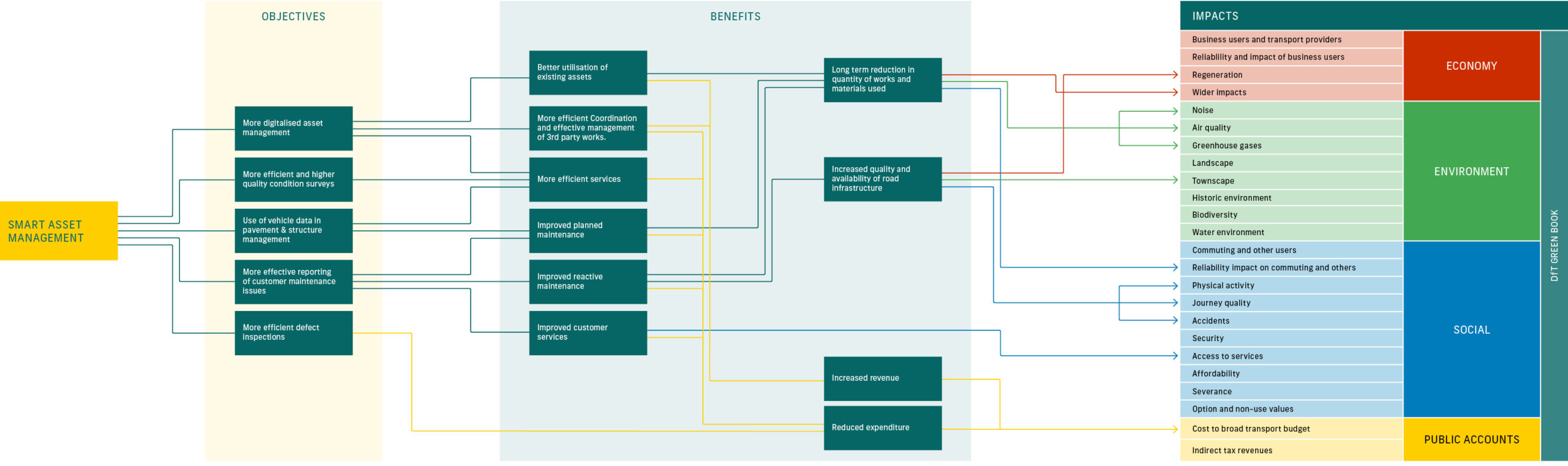
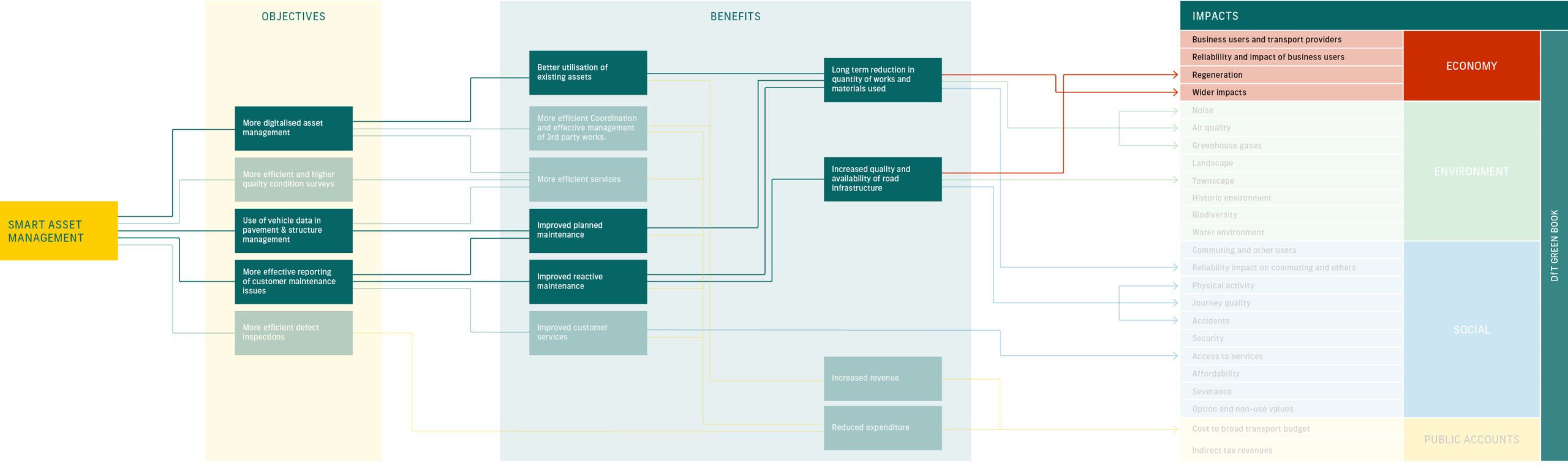
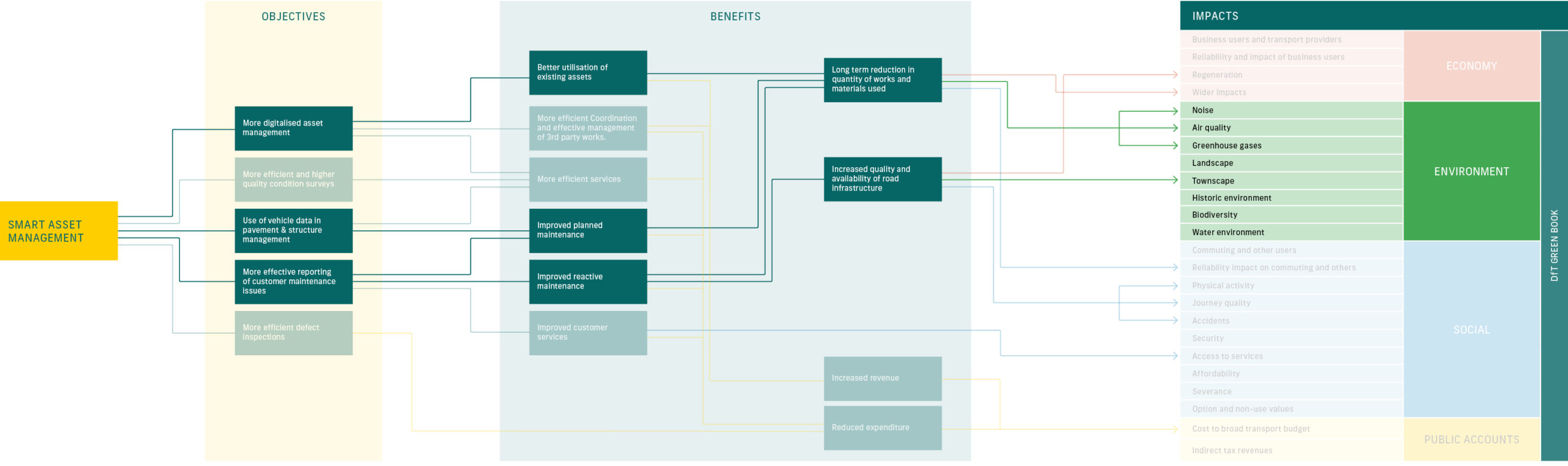
View by impact type:
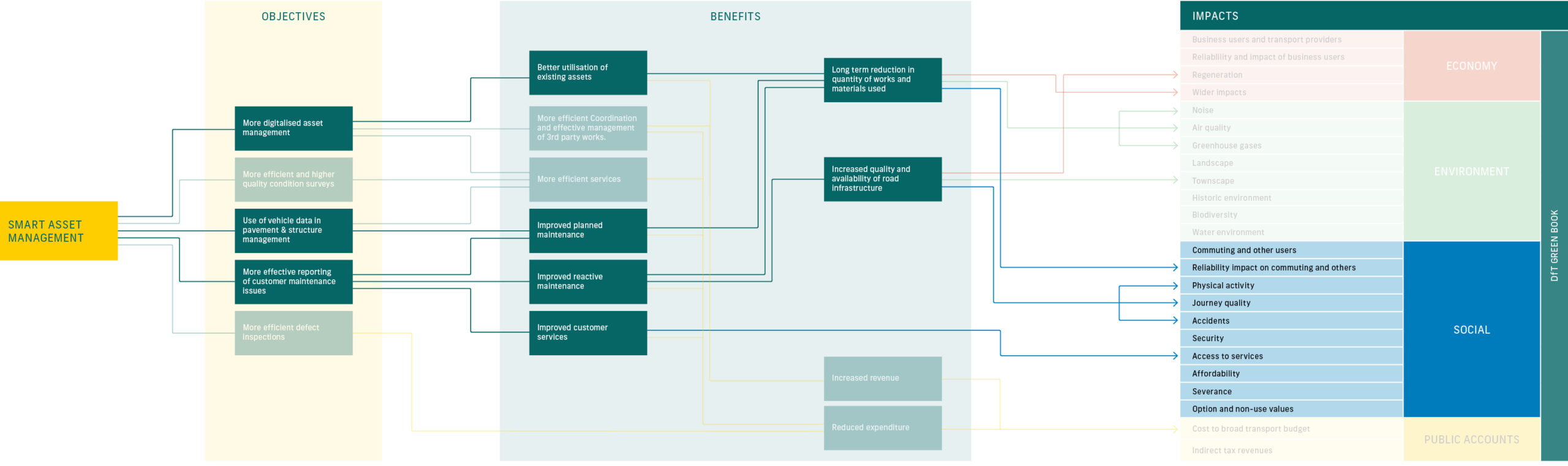
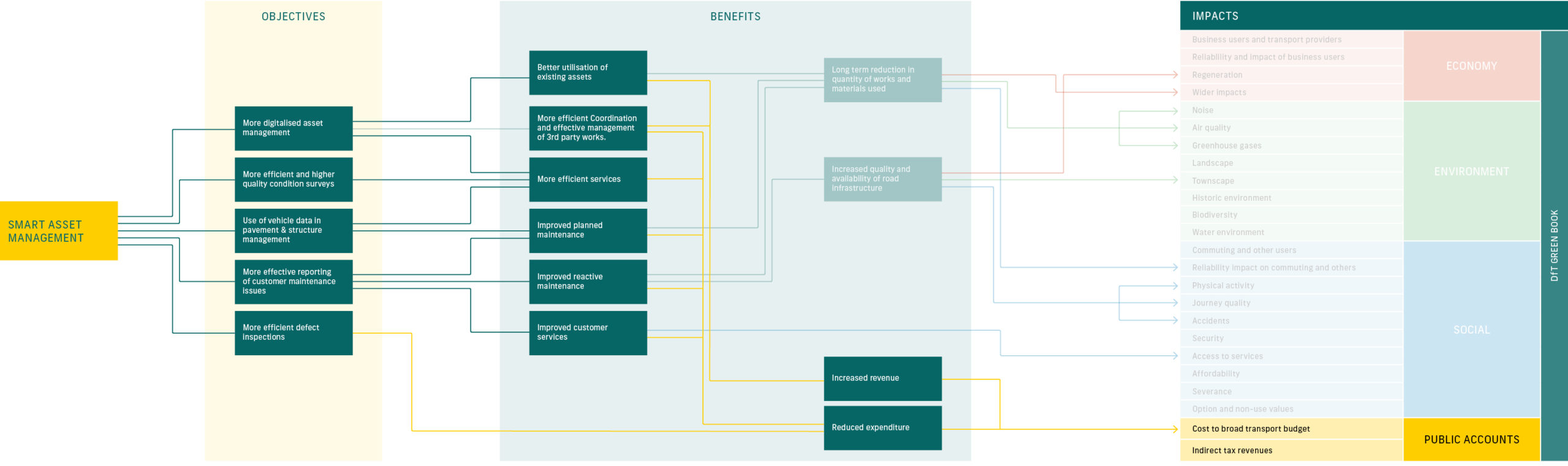
DRAG
Introduction
In this section, the development of plans and specifications is supported by providing the following information:
- Actors: who need to be considered in the development of the system.
- Architecture and Data flows: showing how administrators and users interact and use the system, to help identify and develop the needs and specifications of the system.
- Standards: that are important and how these are used in the context of this use case.
- Possible developments: in practices and technology that may provide opportunities in the future.
Actors
When developing an enhanced asset management process it is good practice to identify the actors who will interact with it, and ensure the system’s design and specification fulfil their needs. The functions of the system can then be described by its interactions with actors (any user or system that interacts with the system).
The following actors and needs have been identified as applicable for an asset management system:
Actor |
Description |
Needs |
Road users |
People who use road infrastructure and equipment | Well maintained roads, Access to services providing information on assets and to report issues, Information on maintenance and renewal works (including streetworks) that can disrupt navigation and be a generator of delays |
Asset Manager |
Role (within the authority) responsible for maintaining roads and the asset management system | Functions that effectively support monitoring, management and reporting of road assets. |
Road maintenance contractors |
Organisations that are contracted by authorities to maintain road infrastructure and equipment. | Facilities to efficiently receive clear and accurate works instructions, identify defects and defect repairs, send status updates, and manage accounts. |
Statutory Undertakers |
Companies and agencies with permission to undertake highway works. | Long term works programmes for co-ordination of works, permits and road occupancy |
Road Inspector |
People (typically within the authority, but maybe part of the maintenance contractor organisations) who assess the condition and defects of road infrastructure and equipment | Facilities to efficiently receive accurate defect reports, plan their inspection routes, and capture and submit inspection records. |
Asset Management System Service Providers |
Software developers and service providers deliver either software or maintained services to support Authority asset management processes | Clarity of the functional needs to support asset management purposes, including the import, export, analysis, validation and reporting of assets and related data |
Data Suppliers |
Typically commercial entities supply asset-related data emanating from various sources, for use by Asset Managers and Road Maintenance Contractors under a commercial arrangement | Understanding of the needs, commercial constraints and delivery restrictions (such as acceptable data formats) for asset management use of data |
Architecture and Data Flows
The data requirements and data flows for asset management are tabulated in Figure 3 and Figure 4.
The idealised architecture and data flows are illustrated in Figure 5.
Interfaces
Interfaces between systems and services will depend on the specific design and the boundaries with other systems (regional, national, international) and services.
The general principle is that interfaces should be specified to use standardised data flows and protocols wherever standards are available. Following standards will support the integration of other systems and services.
Standards
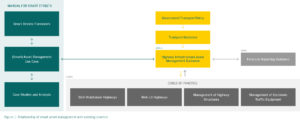
There are limited recognised data standards for sharing asset register and condition data. However established guidance and codes of practice for asset management is available. As illustrated in Figure 1 the UK Roads Liaison Group (UKRLG) provides key asset management guidance for the highways sector in the UK. More information is available on the UKRLG website. Including the ‘Highway Infrastructure Asset Management Guidance Document’ which provides a framework of guidelines and recommendations for asset management and is further supported by several codes of practice published by UKRLG. This guidance is intended to assist Authorities in meeting their statutory asset maintenance obligations, for example, as set out in the Road Traffic Act 1980, and to manage transport assets effectively to maximise both benefits to road users and cost-effectiveness.
The Chartered Institute of Public Finance and Accountancy (CIPFA) has published a Code of Practice on Transport Infrastructure Assets. The code is intended to support consistent, high-quality financial information to support asset management, financial management and financial reporting. Conformance with this code is intended to ensure the satisfaction of Whole of Government Accounts (WGA) requirements for Authorities to report the value of their assets, including transport assets, using standard accounting practices. The CIPFA code requires the calculation of the Gross Replacement Cost and Depreciated Replacement Cost of highway assets. The trends of these metrics can be used as a basis for measuring the effectiveness of asset management and quantifying achievement against intended targets. For example, if the target is to maintain current condition levels, then the depreciated replacement cost should remain relatively level over time in real terms.
The CIHT’s ‘Well Managed Highway Liability Risk’ guidance document provides a risk and evidence-based approach to service delivery and the effective management of highway liability risk exposures. The use of connected data and digitalised processes in asset management can help to achieve this approach effectively and with consistency.
The Highway Maintenance Efficiency Programme (HMEP) recommends that long term strategic planning and estimation of expenditure, alongside long-term asset performance, is essential to improve the management of roads and services. They provide a Lifecycle Planning toolkit that calculates the likely performance of an asset so that future budgets can be prioritised accordingly. The Structures Asset Valuation and Investment Tool (SAVI) provides a similar condition-based decision support tool for structures. It can be used to: carry out the valuation of structures stock, develop prioritised short-term programmes of work, and develop long-term asset management plans. Integrating the functionality of these tools into the asset management system would improve efficiency by enabling these decision support forecasts to be provided automatically without additional effort being required to enter data into separate tools.
Figure 3: The Road User Journey


Start
Understand
Discover
Report
Alert

What the user needs
- ‘Levels of service’ explaining how road infrastructure and equipment is maintained.
- What services are available and the procedures to use them
- Discover asset information
- Who maintains assets and what services are available for them
- History of works for locations or assets
- To report an Issue / Defect
- To be notified of decisions on reported issues and progress repair
- To be alerted about planned roadworks & streetworks
- Location
- Access / route and facilities affected
- Start time and duration
- Reason for road works
What the system needs from the user
- Language / Accessibility requirements
- Location or Topic
- Location of interest
- Any changes to initial journey/trip
- Changes to journey preferences
- Confirm account/profile
- User Location and or location of interest
- Type of issue / asset involved
- Photographic evidence
- Description of issue
- Date / time
- Contact details and preferences
- Asset register and condition data?
- User Location and or area of interest
- Relevant modes of travel
- Contact details and preferences
Data Requirements
- Language / Accessibility information
- User preferences (profile)
- Location or topic
- Levels of service descriptions
- Service usage descriptions
- Variations from Standards
- Planned & emergency roadworks & streetworks data
- Dynamic diversions
- Accident data
- Current weather data
- Signal timing information
- Historic/Current/Future (predicted) traffic network status
- Route restrictions
- Pollution data
- Weather prediction
- Special events information
- Accessibility information
- User preferences (profile)
- Location
- Issue / Defect report
- Photographic
- Date / time
- Contact details
- Contact preferences
- Location / area of interest
- Date / time
- Contact details
- Contact preferences
- Roadworks & streetwork details
DRAG
Figure 4: The Asset Managers Activities


Start
Set Policies and Targets
Maintain Asset Management System
Monitor / Inspect assets
Plan and Programme
Manage Works
Accounting and Reporting
What the Asset manager needs
- Inventory of Assets
- Historic performance data / Performance gaps
- Current asset condition
- Future asset condition and works/spend forecasting
- Informed of data/storage usage
- Informed of system performance status / issues
- Informed of mapping and asset data updates
- Changes to schedules of rates and response levels
- Informed of software bugs / updates
- Inspector schedules
- Inspection reports & defects
- Inspection performance reports – due item alerts
- Reported defects
- Pavement condition reports
- Risk evaluation
- Intervention options forecasting.
- Works proposals and delivery schedule
- Contractor programmes
- Works progress updates
- As built measures and records
- Asset valuation reports
- Budgeting reports
- Performance reports
What the system needs from the manager
- Performance measures and targets
- Budgets and costs
- Implement updates to GIS and asset database
- Implement updates to schedules of rates and response levels
- Implement software updates
- Data/storage maintenance
- Hardware maintenance
- Asset categories
- Inspection frequencies
- Inspector resources / work schedules
- Evaluation / decision criteria
- Intervention levels
- Schedule of rates
- Response levels
- Works instructions
- Calculation values
- Report query formats
Data Requirements
- Asset & condition inventory
- Works records
- Accounts and reports
- GIS datasets
- Asset databases
- Schedule of rates
- Response levels
- Software package updates
- System data / storage reporting
- System performance logs/reporting
- Inspection policy data
- Asset inventory
- Inspection / defect data
- Inspection resource data / preferences / work schedules
- Defect reports
- Pavement condition register
- Evaluation metrics
- Works plans
- Location
- Works details
- Photographs
- Asset & condition inventory
- Works records
- Calculation metrics
- Report templates
DRAG
Figure 5: Idealised Asset Management System architecture

Possible Future Developments
Connected Vehicle Data Research published by DfT suggests that the use of emerging connected vehicle services could provide significant cost savings for asset management.
- Since the publication of the report, several new connected data services have come to market and usage of these is increasing across Authorities.
- Data types involved in these products include processed asset images from smartphone cameras, road surface condition data from accelerometers and crowdsourced defect reports as well as data from vehicles’ own sensors.
- These services will focus on the use of automatically collected data, combined with machine learning algorithms to augment or even replace typically labour-intensive surveys.
- A key advantage is identifying issues as they arise, rather than during scheduled inspections which allow:
- – A greater range of preventative and pre-emptive repairs of assets.
- – Reduction of labour costs due to earlier identification of problems.
- – Reduction of congestion due to more efficient repair and maintenance planning.
Services administered or authorised by an Authority such as refuse collection, or e-scooter rental could provide an ideal source of data for these future asset management services. In preparation for such future developments, Authorities could consider ensuring that the terms of new agreements facilitate the sharing and/or collection of data. Considering this for new agreements would have minimal cost implications, however, adapting existing agreements to facilitate access to data could be a significant barrier later.
On-going developments in technology are likely to continue to change the way that asset managers receive and access information and change the data sources available to Authorities for monitoring and understanding their assets on the network.
In particular, while conventional ITS systems include Authority controlled sub-systems (roadside equipment, traffic control centres), a central focus of current development is on the devices travellers carry with them or have in their vehicles – ‘smartphones’ and ‘sat navs’. These devices can communicate and share information and are anticipated to lead to improved road safety, traffic efficiency, comfort, mobility and sustainability.
The MfSS focuses on the services to be deployed by Authorities and the interfaces to these subsystems. Some of the functions of this use case will be similar regardless of the underlying technology to be deployed. Accordingly, the focus of an Authority should be on building and publishing accurate and complete data sets. When data is accurate, timely and complete, the developing ecosystem of service providers is more likely to use it to enhance their services, and provide publishing services to ensure that the Authority data is used more widely.
- As these developments will continue, Authorities should nevertheless:
- – Develop and make available high-quality data that is easy for service providers to find and use, so making it available to the publis.
- – Focus on service quality and service levels so data feeds can be relied upon and can be dependable.
- – Ensure published standards are used for interfaces wherever possible to maximise the potential for consumption of the published data.
- – Provide opportunities for service providers to trial new services to continue to learn and develop their capability to engage in this area.
- Assess whole life costs when considering investments in conventional ITS systems and investigate the use of other data sources (‘smartphones’, ‘sat navs’, video analytics) as contenders or complementary to traditional ITS solutions.
A relatively recent trend for inspection of high or hard to access structures is the use of unmanned aerial vehicles (UAVs) for inspection surveys. This eliminates risks of working at height, improves cost-effectiveness and potentially improves the quality and consistency of records. However, the use of UAVs presents a new set of risks and limitations. Over the coming years, available products and guidance will be required to optimise and regulate the safe use of UAVs in asset management.